


Metric Explainer: Progressive Actions Under Intense Pressure
Identifying players who consistently look to play forward when receiving the ball under intense pressure.

Football often requires players to handle high pressure situations when receiving the ball. What a player does from there — whether they play safe, recycle possession, or drive forward — often determines whether their team can break defensive blocks and create offensive situations.
Elite profiles possess the ability to convert pressure into progression, consistently advancing the ball even when tightly closed down on reception. Quantifying this skill in-game has been a major challenge… until now.
Our Progressive Action Under Intense Pressure metric captures exactly those situations. It measures how consistently a player produces a meaningful forward action, whether through a progressive pass or carry, when receiving the ball under intense pressure.
By isolating possessions that begin under High or Very High pressure and conclude with a progressive action advancing the ball, this metric highlights the players who are genuinely comfortable operating under pressure and capable of moving the ball forward despite it.
Applied Use Case
Full Backs
Identify Full backs who play forward under pressure.
Full backs are frequently pressed aggressively as opponents look to close teams down closer to the side lines. Those who consistently absorb this pressure and still manage to advance the ball — with a carry or a progressive pass — are extremely valuable to teams that aim to play under pressure.
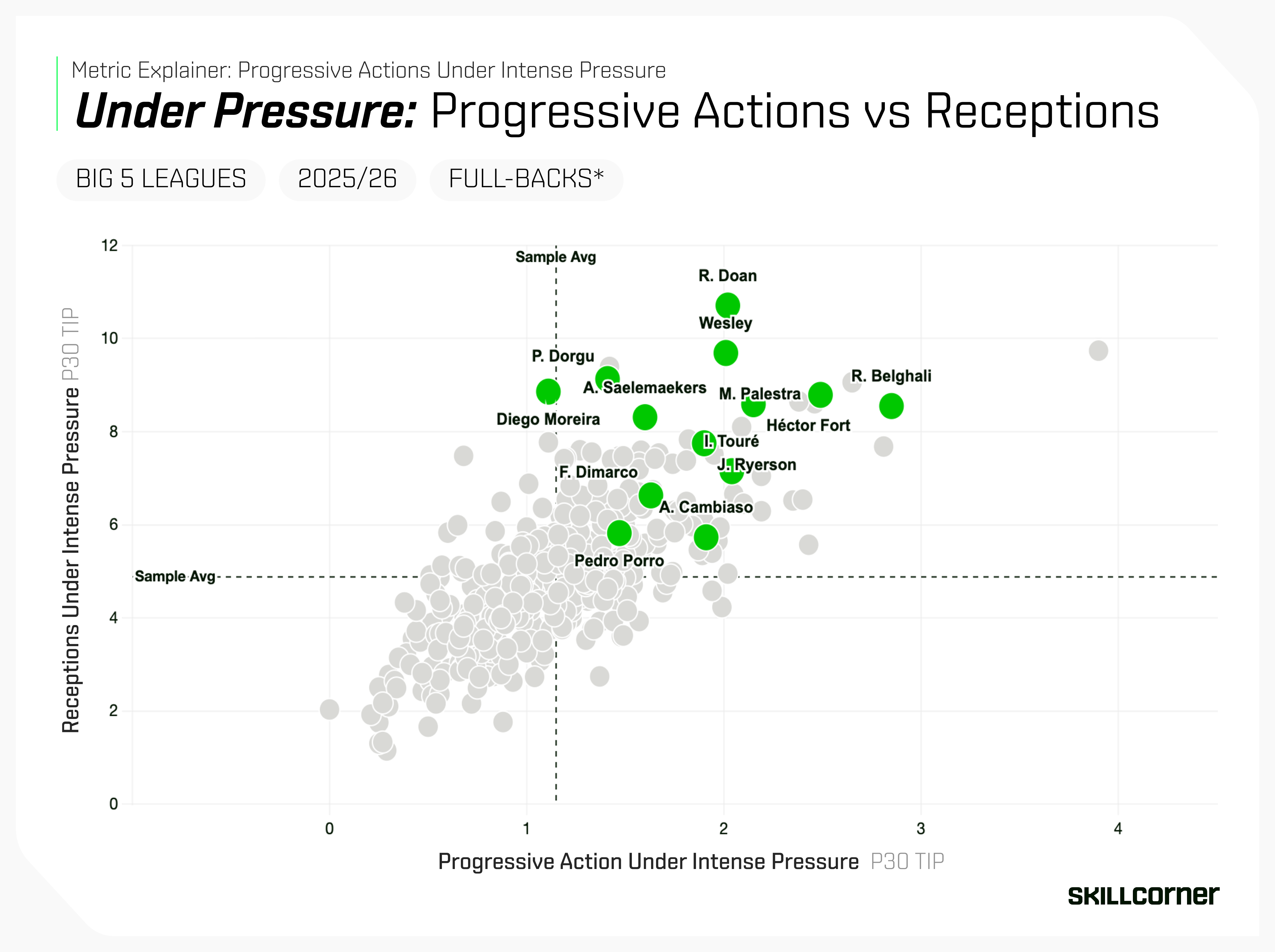
Metric Definition
Progressive Action Under Intense Pressure flags players who receive the ball under intense pressure and respond with a forward action that advances the team up the pitch.
Specifically, it measures possessions that begin from a pass reception under High or Very High Overall Pressure Degree and conclude with a progressive action — defined as a pass or carry that advances the ball at least 8 metres toward the opponent's goal.
The Overall Pressure Degree is driven by four key components: the time defenders have to close down the ball carrier, the space available to the receiver, the ease of available passing options, and the technical difficulty of the reception.
Each of these is assessed on a five-level scale, from Very Easy to Very Difficult.
These elements are then combined into a single, model-based metric — the Overall Pressure Degree — expressed on a scale from None to Very High.
If you'd like to dive deeper into SkillCorner's Playing Under Pressure Framework, check out the full explainer: Introducing SkillCorner's New Pressure Metrics.
.jpg)

