Contextual Scouting: An NWSL-Ready Winger
We used our Game Intelligence data and dedicated Women's Physical Data to find wingers with profiles suited to the NWSL.

The 2026 NWSL regular season ended on November 1. While the top teams head into the playoffs, the rest are already planning next year's rosters.
And there will be more clubs doing it: the league grew to 16 teams in 2026, with Boston Legacy and Denver Summit joining the league. Neither had an expansion draft, so both had to build their rosters from scratch. Atlanta and Columbus join in 2028, and the league is already preparing to add teams 19 and 20.
More clubs means more demand for players suited to the demands of the NWSL. So who outside the league could step in tomorrow and look like they’ve always been there?
The Brief
We're scouting a winger for an NWSL club. The target: players who don't play in the NWSL yet, but already play like the league's best wingers.
Unlike our Pressing No. 8 piece, we measure every player against the NWSL itself. Every score in this article is calculated against NWSL 2026 wingers. Each metric is turned into a percentile: 80 means she's ahead of 80% of the NWSL's wingers on it. Pillar scores average those percentiles, and the index blends the pillars.
The search spans 16 competitions outside the NWSL:
- The USL Super League, the US's other professional league.
- Europe: England's Women's Super League and WSL 2, Spain's Liga F, France's Première Ligue, Germany's Frauen-Bundesliga, Italy's Serie A Women, Portugal's Liga BPI, Sweden's Damallsvenskan, Norway's Toppserien, Denmark's A-Liga, and the Czech Women's First League.
- Beyond Europe: Mexico's Liga MX Femenil, Brazil's Brasileirão Feminino, Australia's A-League Women, and Japan's WE League.
We use the 2025/26 season for leagues on a European calendar, and the 2026 season for calendar-year leagues (NWSL, Brazil, Sweden, and Norway). Players need at least five games as a winger, playing 60 minutes or more in each, to qualify.
What does an NWSL winger look like?
Before building a profile, we need to understand what makes NWSL wingers different.
The chart below compares the average NWSL winger with the average winger in each of the other 16 leagues, metric by metric. Each gray dot represents a league; the green dot is the NWSL, with its rank among all 17 leagues on the right. Metrics in bold are the ones our profile will use.
Metrics in bold are used in our profile. TIP / OTIP = minutes with her team / the opponent in possession.
Positions: league average vs the median league, scaled to the typical spread between leagues.
* Wingers without a qualifying sprint count as the slowest.

NWSL wingers don't stand out for doing more than other wingers. They stand out for doing everything faster. They have the highest peak velocity of any league, and they're tied with Portugal's wingers as the quickest to reach a sprint. They are only 10th on total distance, but only wingers in Italy and the Czech Republic cover more ground at sprint speed.
The same is true of everything else they do. Without the ball, they make more runs than most, behind only France and Germany, and a bigger share of those runs are fast, in behind and dangerous than in almost any other league. They carry the ball less often than most, but faster, again second only to Italy. And they don't defend more, but they defend faster. No other league's wingers engage the ball carrier at high speed as often.
Peak velocity shows how big the gap can be.
Nearly half of NWSL wingers (46%) average 30 km/h or more in their three fastest games. Elsewhere, it's 14%.
Temwa Chawinga of KC Current is the fastest in the whole sample (33.3 km/h); the fastest outside the NWSL is Merveille Kanjinga of Paris Saint-Germain (31.7), a name that comes back later.
In the NWSL, explosiveness, peak velocity, and runs in behind aren't nice-to-haves. They're what a winger needs just to keep up. So we're scouting for wingers who already play that way, at high speed and high intensity.
Our scouting index has two equal halves. The first is physical: speed and explosivity. The second is output: how each player puts that to use.
1. Physical: Fast and Explosive (50%)
This is where NWSL wingers stand out most, making speed the foundation of this profile. A winger who can't keep up won't get to show the rest of their game, which is why this pillar makes up half of the index. It runs on SkillCorner's Women's Physical Data, built on speed thresholds specifically designed for the women's game.
We chose four qualities where NWSL wingers stand out. They rank first of 17 leagues on two of them and third on the other two. All four are weighted equally, so no single one dominates:
- Peak Velocity: their fastest speed in a game, averaged over their three fastest games. This is the ceiling on how fast they can go, and it decides who wins the race to a ball played in behind. It's also what sets NWSL wingers apart most.
- Time to Sprint: how quickly they accelerate to sprinting speed (23 km/h), averaged over their three quickest games. A fast winger who takes too long to get going gets caught before they get away. NWSL wingers are tied with Portugal's for the quickest.
- Explosive Accelerations to High Speed: how often they accelerate from a standing or slow start to reach high speed (19 km/h), per 90 minutes. This is the burst that beats a defender off the mark. NWSL wingers rank third. Count only the bursts that carry on into a full sprint, and they rank first.
- Sprint Distance: how many meters they cover at sprint speed (above 23 km/h) per 90 minutes. Peak velocity only matters if they reach it again and again. NWSL wingers rank third.
Total distance and high-speed running distance aren't part of this pillar, and that's deliberate. As we saw, the NWSL is only 10th on both, so a winger who simply runs more wouldn't necessarily fit.
We look at the four metrics in two pairs. The first pair is about speed: peak velocity, and how quickly they reach a sprint.
The two tend to go together: the faster a winger is, the sooner they usually reach a sprint. NWSL wingers crowd the top-right corner. Of them, 61% sit above and to the right of both gray lines, the medians for wingers outside the NWSL.
From the other leagues, that figure sits at 37%. Merveille Kanjinga of Paris Saint-Germain is the standout. No winger outside the NWSL has a higher peak velocity, and only Sydny Nasello of Tampa Bay Sun gets to a sprint quicker.
The second pair is about volume: how often a player bursts to high speed, and how much ground they cover at sprint speed, both per 90 minutes.
These two usually go together as well, but the wingers at the edges show they don't have to. Alyssa Thompson does both: she sits far right and high up. That's no surprise: she played in the NWSL for Angel City before joining Chelsea in 2025, and still moves like an NWSL winger. Kerolin of Manchester City, another former NWSL winger who has since joined Barcelona, bursts almost as often, 13.3 times per 90, but covers less ground at sprint speed. Ronja Foss Arnesen of Lillestrøm, who has since returned to Vålerenga, and Sanne Lekven of Aalesund are the opposite: fewer bursts, but they cover the most ground at sprint speed outside the NWSL.
Together, the four metrics make up the Physical score. Who makes the top 5 outside the NWSL?
Top 5 | Physical (outside the NWSL)
- (CD) Merveille Kanjinga, Paris Saint-Germain, Première Ligue
- (US) Alyssa Thompson, Chelsea, Women's Super League
- (ES) Belén Martínez, Alhama CF, Liga F
- (NO) Ronja Foss Arnesen, Lillestrøm, Toppserien
- (ENG) Freya Godfrey, London City Lionesses, Women's Super League
Two of them stand out on pure speed. Kanjinga's peak velocity of 31.7 km/h is well above the NWSL median of 29.7, and she gets to a sprint in 1.06 seconds against an NWSL median of 1.39. Belén Martínez, third, is close behind on both, at 31.0 km/h and 1.10 seconds. She does all that at 37, playing for Alhama CF, who finished second-to-last in Liga F and were relegated.
Thompson and Foss Arnesen, second and fourth, stand out on volume instead. Thompson makes 14.0 explosive accelerations to high speed per 90, the most of any winger we looked at. No qualifying NWSL winger makes more than 12.0. Foss Arnesen covers 539 meters per 90 at sprint speed, more than double the NWSL median of 250. Only Temwa Chawinga covers more (544).
Freya Godfrey of London City Lionesses, fifth, gets there another way. She doesn't lead on any one metric, but she's in the top 25 of the 390 wingers outside the NWSL on all four.
All five beat the median NWSL winger on all four metrics. Only 14 of the NWSL's own 51 wingers do that.
2. Output: What They Do With It (50%)
Speed only matters if a player does something with it. The other half of our index measures what makes a good winger in any league, not only in the NWSL. It has four equal parts: the runs they make without the ball, what they do with it, the value they create, and how they defend.
Off the Ball (12.5%)
Off the Ball looks at the runs made while a teammate is in possession. NWSL wingers rank in the top three of the 17 leagues on all four metrics here.
Half of the score relates to run frequency. The other half describes those runs: the share at high speed, the share in behind, and the share that are dangerous. So a winger with a low number of runs can't score well just because the runs they do make are good. And a winger who runs a lot isn't rewarded three times for it. One run can still count in all three shares, and that's on purpose. NWSL wingers stand out on all three, so a run that is fast, in behind, and dangerous should count for more. These are the four metrics:
- Off-Ball Runs: how often they make a run while a teammate has the ball, per 30 minutes of their team's possession (NWSL rank: #3 of 17 leagues).
- Runs at High Speed (%): the share of runs made at high speed (NWSL rank: #3 of 17).
- Runs in Behind (%): the share of their runs that go beyond the last defender. Only wingers in the Czech Republic have a higher share (NWSL rank: #2 of 17).
- Dangerous Runs (%): the share of their runs that would put them in a dangerous position if they got the ball (NWSL rank: #2 of 17).
This chart shows every winger on each of the four.

The wingers at the top of each column are rarely the same. Yiyi Relea of Alhama CF makes 49.0 runs per 30 minutes of possession, the most of any winger in our sample. Her teammate Belén Martínez makes the highest share at high speed outside the NWSL, 42%, against an NWSL median of 25%. But only 12% of all her runs go in behind. Lucía García of CF Monterrey has the highest share in behind and 65% of her runs are dangerous, but she only makes 22.3 runs per 30 minutes.
Together, these four metrics make up the Off the Ball score. These are the three highest outside the NWSL. They don’t lead any of the run share data points, but they're above the NWSL median on all four metrics.
Top 3 | Off the Ball (outside the NWSL)
- (ENG) Lucy Ashworth-Clifford, Ipswich Town, WSL 2
- (AZ) Yiyi Relea, Alhama CF, Liga F
- (DE) Nastassja Lein, 1. FC Nürnberg, Frauen-Bundesliga
Ashworth-Clifford plays in England's second tier. She makes 39.5 runs per 30 minutes of possession, 38% of them at high speed. Lein has almost the same profile, for a team that finished 11th of 14 in the Frauen-Bundesliga. Foss Arnesen and Rebecka Blomqvist of Eintracht Frankfurt are fourth and fifth.
On the Ball (12.5%)
Getting into dangerous positions is only part of the job. Once the ball reaches them, do they make something happen? Three metrics, weighted equally:
- Dangerous Passes Completed: completed passes that put a teammate in a dangerous position, per 30 minutes of team possession (NWSL rank: #3 of 17).
- Speed on Long Forward Carries: how fast they move when carrying the ball forward a long way (NWSL rank: #2 of 17).
- Keeping the Ball Under Intense Pressure: how often they receive the ball under intense pressure and keep it, per 30 minutes of possession (NWSL rank: #3 of 17).
This chart shows every winger on each of the three.

No one leads all three. Klara Bühl of Bayern Munich completes more dangerous passes than any winger, NWSL included, 7.4 per 30 minutes, but her long carries are only about as fast as the NWSL median. Dasia Torbert of DC Power FC, in the USL Super League, keeps the ball under intense pressure most often, 8.2 times per 30 minutes.
The top 3 are above the NWSL median on all three. Here they are:
Top 3 | On the Ball (outside the NWSL)
- (SE) Rebecka Blomqvist, Eintracht Frankfurt, Frauen-Bundesliga
- (DE) Nicole Anyomi, Eintracht Frankfurt, Frauen-Bundesliga
- (BR) Kerolin, Manchester City, Women's Super League
Two of the three play for Eintracht Frankfurt. Blomqvist's long forward carries average 19.5 km/h, against an NWSL median of 16.4. She also keeps the ball 7.2 times per 30 minutes after receiving it under intense pressure, against an NWSL median of 4.4. Kerolin is close behind her on that, at 7.2 as well.
Value Created (12.5%)
This part looks at the end product: how much their actions increase their team's chance of scoring. It uses SkillCorner's Expected Possession Value (EPV) model, which our piece on wingers' on-ball impact explored in more depth.
We take two metrics, weighted equally:
- Value From Passes: how much their passes add to their team's chance of scoring, per 30 minutes of possession.
- Value From Possessions: the same but for carries, again per 30 minutes of possession.
Here are the two side by side.
The two don't always align. Lekven adds more value from her possessions than any other winger, 65.2 per 30 minutes. But her passes take value away, so she misses the top 3. Both are important to our search.
These are the three highest outside the NWSL:
Top 3 | Value Created (outside the NWSL)
- (CZ) Michaela Khýrová, Sparta Prague, Czech Women's First League
- (DE) Klara Bühl, Bayern Munich, Frauen-Bundesliga
- (CD) Merveille Kanjinga, Paris Saint-Germain, Première Ligue
Khýrová's passes add more value than those of any other winger outside the NWSL, more than four times the NWSL median. Bühl and Kanjinga are well above the NWSL median on both passes and possessions.
Defending (12.5%)
Wingers defend too. Half of the score is how often they engage the ball carrier at high speed. The other half relates to the outcome: do they win the ball back or disrupt the opposition attack.
These are the three metrics:
- Engagements at High Speed: how often they close down or challenge the ball carrier at high speed, per 30 minutes of opposition possession. NWSL wingers don't engage more than most, but no other league's wingers do it at high speed as often (NWSL rank: #1 of 17).
- Ball Won Back: how often their defensive engagements end with their team winning the ball back, per 30 minutes of the opponent's possession.
- Attacks Disrupted: how often their defensive engagements disrupt the opponent's possession without their team winning the ball back, per 30 minutes of the opponent's possession.
This chart shows every winger on each of the three.
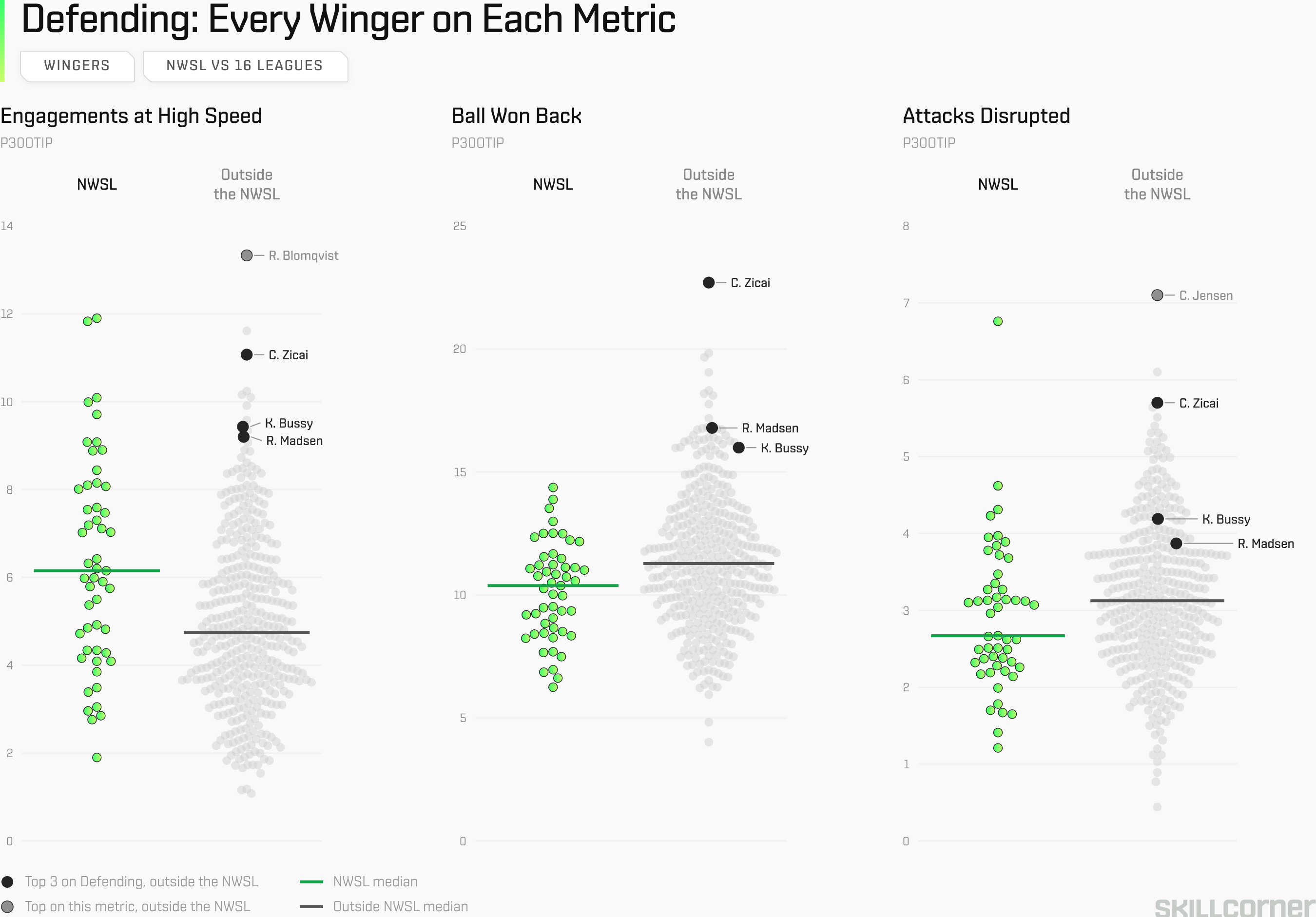
NWSL wingers engage at high speed more often than wingers outside the league (a median of 6.2 per 30 minutes, against 4.7). But they win the ball back less (10.4, against 11.3), and they disrupt fewer attacks (2.7, against 3.1). Speed alone isn't enough.
Blomqvist engages the ball carrier at high speed 13.3 times per 30 minutes, more than anyone in our sample, but she wins the ball back only 8.5 times. A good winger in any league does all three.
These are the three highest outside the NWSL:
Top 3 | Defending (outside the NWSL)
- (DE) Cora Zicai, VfL Wolfsburg, Frauen-Bundesliga
- (FR) Kessya Bussy, VfL Wolfsburg, Frauen-Bundesliga
- (DK) Rikke Madsen, HB Køge, A-Liga
Zicai wins the ball back 22.7 times per 30 minutes of the opponent's possession, the most of any winger, NWSL included. She's also third outside the NWSL on the other two metrics. Her Wolfsburg teammate Bussy is second.
The Output Score
Together, the four parts make up the Output score. This chart shows how the best outside the NWSL get there.
Kanjinga has the best Output score without leading any single part: she's simply above the NWSL median on all four. Kerolin gets there on the ball and through her defending. Ashworth-Clifford, the Off the Ball leader, adds solid defending. Bühl gets there through the value she creates. Ellie Brazil of Southampton, in WSL 2, pairs that end product with strong defending.
Top 5 | Output (outside the NWSL)
- (CD) Merveille Kanjinga, Paris Saint-Germain, Première Ligue
- (BR) Kerolin, Manchester City, Women's Super League
- (ENG) Lucy Ashworth-Clifford, Ipswich Town, WSL 2
- (DE) Klara Bühl, Bayern Munich, Frauen-Bundesliga
- (ENG) Ellie Brazil, Southampton, WSL 2
Building the NWSL-Ready Winger Index
The index blends the two pillars equally: 50% Physical and 50% Output.
And because the scale is the NWSL's own, we can say where each player would rank if they joined the league tomorrow.
With only two pillars, one chart shows the whole index. The further up and to the right a winger sits, the higher their score.
The two don't always move together. To compare them fairly, we look at how many NWSL wingers each player beats on each pillar. Kadidiatou Diani of OL Lyonnes beats 51% of them on Physical, but 88% on Output. Freya Godfrey of London City Lionesses is the opposite. She beats 86% on Physical, but only 59% on Output, which leaves her 19th on the index outside the NWSL. Only one winger outside the NWSL beats 90% of NWSL wingers on both: Merveille Kanjinga.
Who sets the bar?
So who are the NWSL wingers setting the bar? These are the league's top 10 on the index this season:
Top 10 | NWSL-Ready Winger Index (NWSL wingers, 2026)
- Temwa Chawinga, KC Current
- Racheal Kundananji, Bay FC
- Jordynn Dudley, Gotham FC
- Trinity Rodman, Washington Spirit
- Cloé Lacasse, Utah Royals
- Solai Washington, Orlando Pride
- Paige Cronin, Utah Royals
- Emma Sears, Racing Louisville
- Lizbeth Ovalle, Orlando Pride
- Cece Kizer, Utah Royals
Chawinga is the benchmark. She ties Rodman for the best Physical score, and only Kundananji scores higher on Output. To break into this top 10, a winger from outside the league needs an index score of 79.4.
The Shortlist
Twelve wingers outside the NWSL score high enough to make the NWSL's own top 10. That's our shortlist.
They come from seven leagues. Merveille Kanjinga would rank second in the NWSL, behind only Temwa Chawinga. Alyssa Thompson, Klara Bühl, and Kerolin would all be around fourth.
The bottom of the list is crowded. The last five are within three points of the line, and three more wingers miss it by two points or less. Small changes in how we weight the metrics could move names in and out, so treat them as close calls rather than a hard cut.
This chart shows how the top 10 get there. Kanjinga is strong on both pillars. Thompson, Salma Paralluelo of Barcelona, and Foss Arnesen get there mostly through speed, and Kerolin mostly through her output.
Merveille Kanjinga of Paris Saint-Germain tops the list. At 23, she has the best Physical and Output scores of any winger outside the NWSL, and that's from her games on the wing alone: at PSG she splits her time with center forward.
Alyssa Thompson of Chelsea, still only 22, is second, Klara Bühl of Bayern Munich third, and Kerolin of Manchester City fourth. Bühl stands out for the value she creates, Kerolin for her work on the ball and her defending. Thompson and Kerolin both spent several seasons in the NWSL, with Angel City and the North Carolina Courage, so it makes sense they still play that way. Seeing them near the top is a good sign the index is picking up the right things.
Salma Paralluelo, 22, now at OL Lyonnes after leaving Barcelona, and Vera Blom of IF Brommapojkarna in Sweden, 21, tie for fifth. Lily Crosthwaite of Birmingham City, in WSL 2, is seventh. Justine Rouquet of Montpellier, Ronja Foss Arnesen of Lillestrøm, and Rebecka Blomqvist of Eintracht Frankfurt tie for eighth. At 19, Rouquet is the youngest on the list, and she makes more than double the NWSL median of runs in behind. Luany of Atlético Madrid and Ellie Brazil of Southampton, right on the line, complete it.
It's a young list: five of the 12 are 22 or younger. Just below the line are Linda Caicedo of Real Madrid, only 21, Yoshino Nakashima of Sanfrecce Hiroshima Regina, and Sophie Peskett of Ipswich Town. Freya Godfrey, 21 too, finishes 19th overall, but her Physical score ranks fifth outside the NWSL.
Some of them may also be easier to sign than others. Bühl's contract with Bayern Munich and Luany's with Atlético Madrid both end in June 2027, so unless they renew, either could leave on a free transfer next summer. Blom is only on loan at Brommapojkarna, so any move would be up to her parent club, Hammarby.
Others will be harder to sign. Kanjinga is under contract at PSG and Thompson at Chelsea until 2030. Kerolin and Paralluelo signed new deals this summer, at Barcelona and OL Lyonnes, that also run to 2030.
Contextual Scouting: From Data to Decision
We set out to find wingers who could join an NWSL club and immediately look like the league's best.
Measuring players against the demands of the NWSL showed exactly what that means: peak velocity, explosive bursts, runs in behind, and speed without the ball too, not just distance covered. And it showed that the supply line is there: 12 wingers from seven leagues would already make the NWSL's top 10.
Some of the names are obvious. Others, like Justine Rouquet and Lily Crosthwaite, emerge here as interesting options.
The aim, as always, was not to find the best winger in the world, but the best one for this league, right now.