Game Intelligence: Bringing The Unseen In Basketball To Light
Understanding the HOW and WHY a play happened rather than focusing on the WHAT
Highlighting The Game Through The Data
"I don’t believe in statistics. There are too many factors that can’t be measured. You can’t measure a ballplayer’s heart." Red Auerbach
One quote, one explanation of what makes basketball what it is, what’s at the core of the game. Basketball isn’t about box-scores or cold, lifeless numbers. It’s about the plays that are ingrained in your brain and define future tactics and game philosophy. Coach Auerbach may not have believed in numbers in the 60s, there wasn’t much to do with them anyway and they weren’t able to illustrate the whole story. Data isn’t just a factual observation anymore, it’s the insight that transforms averages into greatness.
XY Tracking And Events, A Rich Data Source
XY tracking allows a frame by frame spatial mapping of the players and court to better understand what is happening at all times. It’s the industry standard that we take to the next level by tracking continuously all 10 players and the ball, including extrapolation of off screen players. We use a single broadcast feed, allowing us to monitor games through 19+ competitions and 10 years of video archives on selected leagues.. We go even a step further with our AI-powered proprietary technology by linking this data to key offensive or defensive play-by-play events, such as shots, steals, rebounds…Through our Game Intelligence product we added an extra layer; Dynamic Events.
Dynamic Events, The Winning Margin
In our ecosystem, Dynamic Events is the bond between raw tracking data and standard game events. XY tracking generally creates millions of data points per game which can often be complicated and time-consuming to go through for analysts. Dynamic Events filters through all this to create actionable insights.
This translates into On Ball and Off Ball Actions.
On Ball Actions, the HOW behind every action
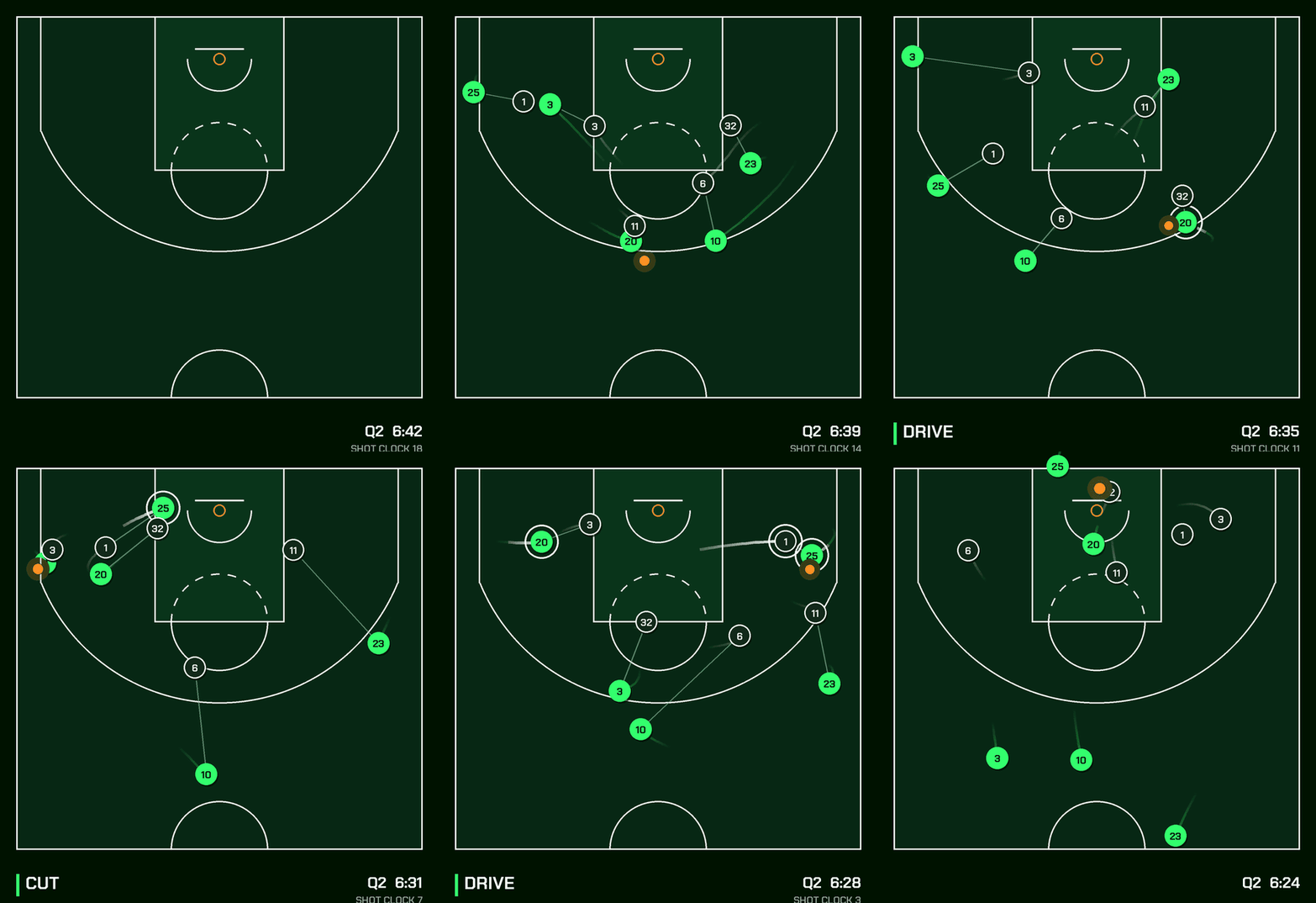
Traditional events tend to tell you what a player did. Player X got a rebound, took a shot and got a foul. Dynamic Events goes a step further by showing HOW that happened. Was the drive created off a screen or in isolation? How much space was given by the defender? Was the shot highly contested? We link the tracking data to each ball action in order to transform a simple box score into a full story. Combined with off-ball actions, analysts can follow a possession from the screen that created the advantage all the way up to the shot that came from it. This allows analysts to compare players based on similar situations rather than on raw totals. Coaches can see which aspects of their system are leading to good results and which players are the driving forces behind their favorite actions in their playbook.
Off Ball Actions, The Unseen Game
On ball actions are only half of the story. Where traditional events log what the player who scored did, Dynamic Events can track the tactical work of the players who aren’t on the ball. Thanks to our tracking data, we can categorize and map off ball runs to identify a player's contribution beyond his ball handling. How many useful crashes did a player do during a game? Did a screen lead to a basket? Did a defender manage to execute a successful boxout? This tactical insight allows teams to go further in their analysis and properly identify who is executing their drills correctly and bringing that extra edge to a play.
A Deeper Look Into The Unseen
- Picks: the screen behind the play:
Almost every half-court possession runs through a screen, but traditional box scores never actually record them. Dynamic Events changes that by identifying each pick, who set it, who used it and where it happened and adding much more context to these events. With over 20 attributes it is possible to identify what the screener did after setting the screen. What type of defense was put on the screener and what was his defender's depth at that moment. Analysts can see much more clearly who consistently frees up teammates, how often do successful plays start by a screen. If you are a scout, this shows the things that very rarely make it to the highlight reels but actually creates an open look.
- Drive: not just a dribble to the rim:
Drives are quite obvious to count but it becomes quite difficult to judge their usefulness. Two players can both have 10 drives but offer very different values to a play. With Dynamic Events it’s possible to attach the situation to each drive: where it started, what was the defense’s reaction to it, how it ended, did a defender stunt on the drive?
This allows a way to better identify if a player simply got to the rim or if he brought much more, like bending a defense, or creating the opportunity for an open 3,helping coaches better identify which drives came from a designed play or from one-on-one creations, which players created gravity around them when they initiated a drive.
- Boxout and Crash: A deeper understanding of the rebound battle:
Box scores count the rebounds, but they don’t clock the work that led to a successful one or to a great defense that prevented one. Dynamic Events capture who executed the boxout. If it’s a defensive player, did he keep his matchup from getting the rebound? Who crashed and from where? As mentioned before, highlights don’t show who does the dirty work, our data does.
These three examples are a small sample of what is captured through Dynamic Events.

Dynamic Events
We are continuously adding advanced in-game actions to show what players do beyond the highlight reels. We currently cover over a dozen different Dynamic Events with an ever-expanding list of attributes:

A More Efficient Approach To Scouting
Dynamic events allow teams to make the shift from raw data to true tactical insight. Where it would usually take analysts months to create the proper queries to identify a particular play, Dynamic Events allows for instant results with very little programming complexity. This allows a quicker access to the data without sacrificing on the quality and depth of those insights.
But speed is only half the value, Game Intelligence allows scouts to better determine player resilience when it comes to creating looks under pressure, their decision making, spatial awareness etc. Insights that go much further than standard reports that focus on when a player has the ball, not what he’s doing in the shadows. It becomes easier to find a true fit beyond the noise of highlight videos.
Want to know more about our Dynamic Events and attributes, reach out today.