


Mining third-tier leagues for top-tier talent
As prices go up, scouts must go down.
%20(1).png)
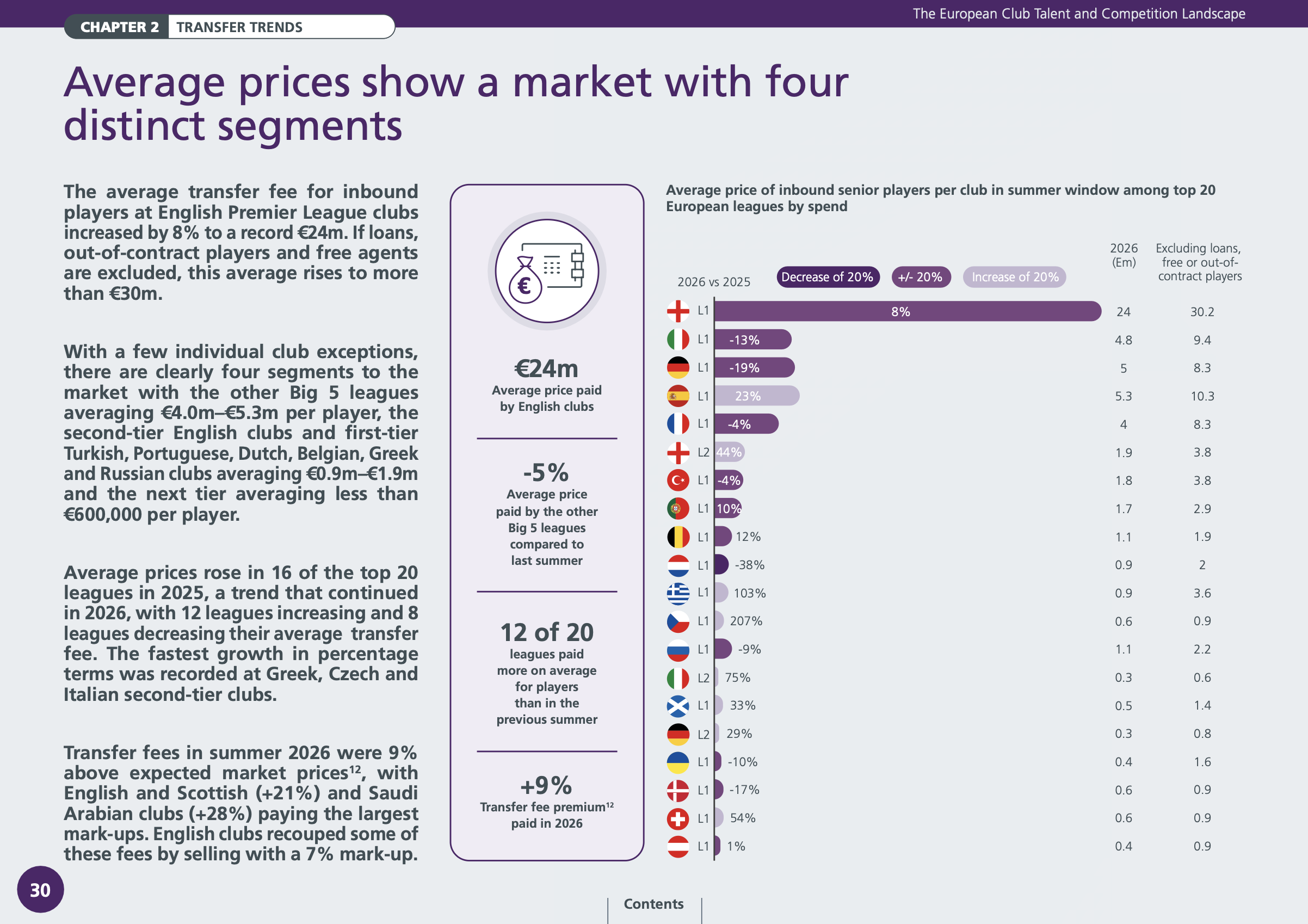
The transfer market has split into four. Premier League spending power has launched England’s top flight into a new stratosphere, splintering the rest of Europe.
In the latest European Club Talent and Competition Landscape report, well worth a full read, Andrea Traverso, UEFA Executive Director Finance, evidences that claim.
“While all major markets were active and 12 countries broke their transfer spend record, it was another significant increase in English club transfer activity that was the biggest news. Their estimated €4.6bn spend this summer is larger than that of the next eight largest European countries combined.
“English clubs were involved in more than 60% of the deals and paid an average of around €24m (£20.7m) per inbound player, compared with only around €4m (£3.4m) to €5m (£4.3m) in the other major European leagues, underlining a widening gap in purchasing power.”
With the exception of a select group of individual clubs, the UEFA report breaks down the new four-tiered transfer landscape into the following groups:
- ENG1
- ITA1, GER1, ESP1, FRA1
- ENG2, TUR1, POR1, BEL1, NED1, GRE1, CZE1, RUS1
- The rest…
Essentially, if a Premier League club enters the race for a player, it’s game over for anyone outside that world.
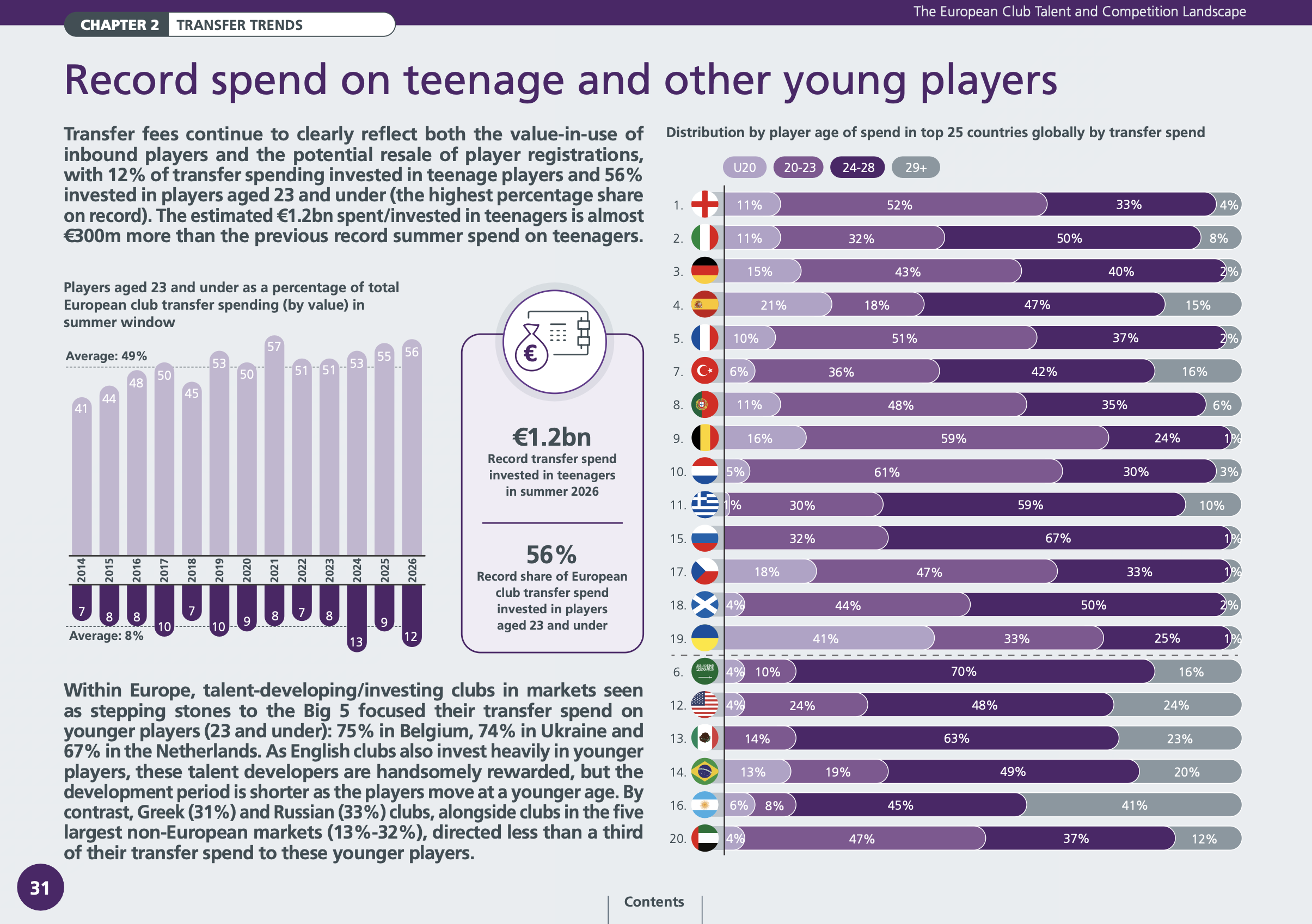
The mechanic for competing with these super-spenders is also being eroded. The richest clubs are investing in young players and the arms race for high-potential (high-resale) talent is accelerating to unprecedented levels. UEFA cites the 56% of transfer spending invested into players aged 23 and under as the highest share on record, while teenage transfer fees surpassed the €1 billion mark for the first time.
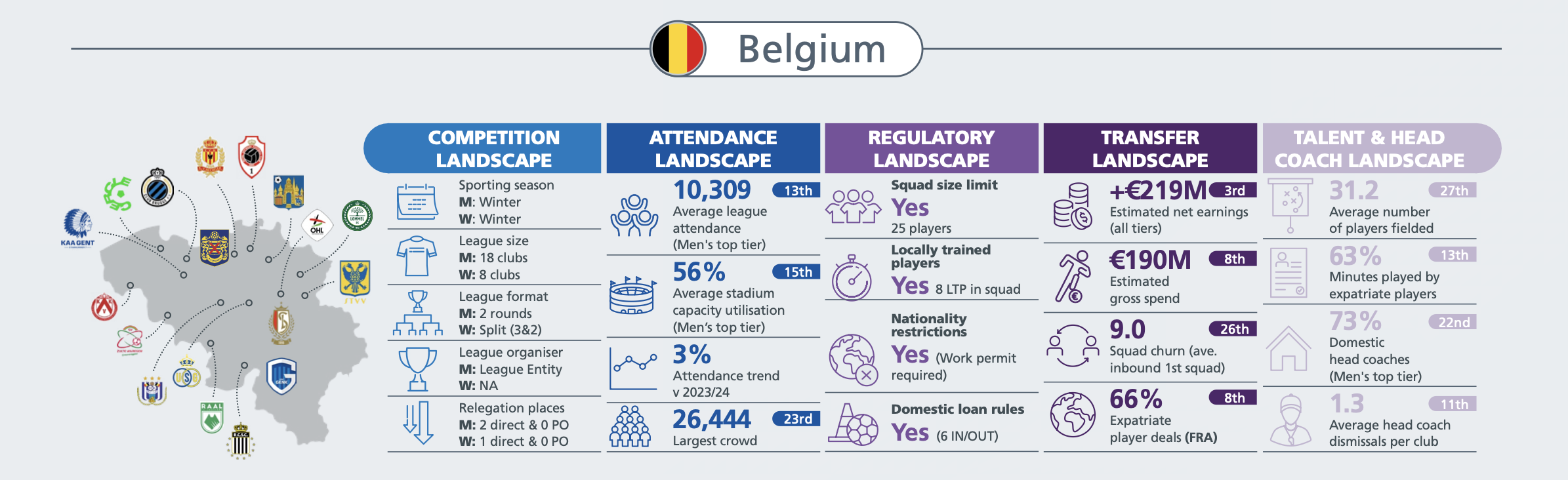
As always, Belgium prove that investing in youth is still a viable strategy for clubs outside those first two transfer tiers. Across all tiers, Belgian clubs diverted 75% of their transfer spend into players aged 23 and under and ranked third for estimated net earnings with €219m. However, they also ranked in the top 10 for gross spend; it has taken time to build up that kitty.
So, for clubs looking to build their prospects portfolio, where is the value? As prices climb higher, clubs must travel in the opposite direction.
A descent down the Big Five league ladders unearths plenty of opportunity. Principally, the pool of players is larger and younger. You have a bigger pond to fish from.
When looking at first to third tiers for the Big Five Leagues across the past two seasons, the U23 and U21 share is larger in the third tier when sliced three different ways and even when excluding reserve sides that feature in Spain, Italy and Germany.
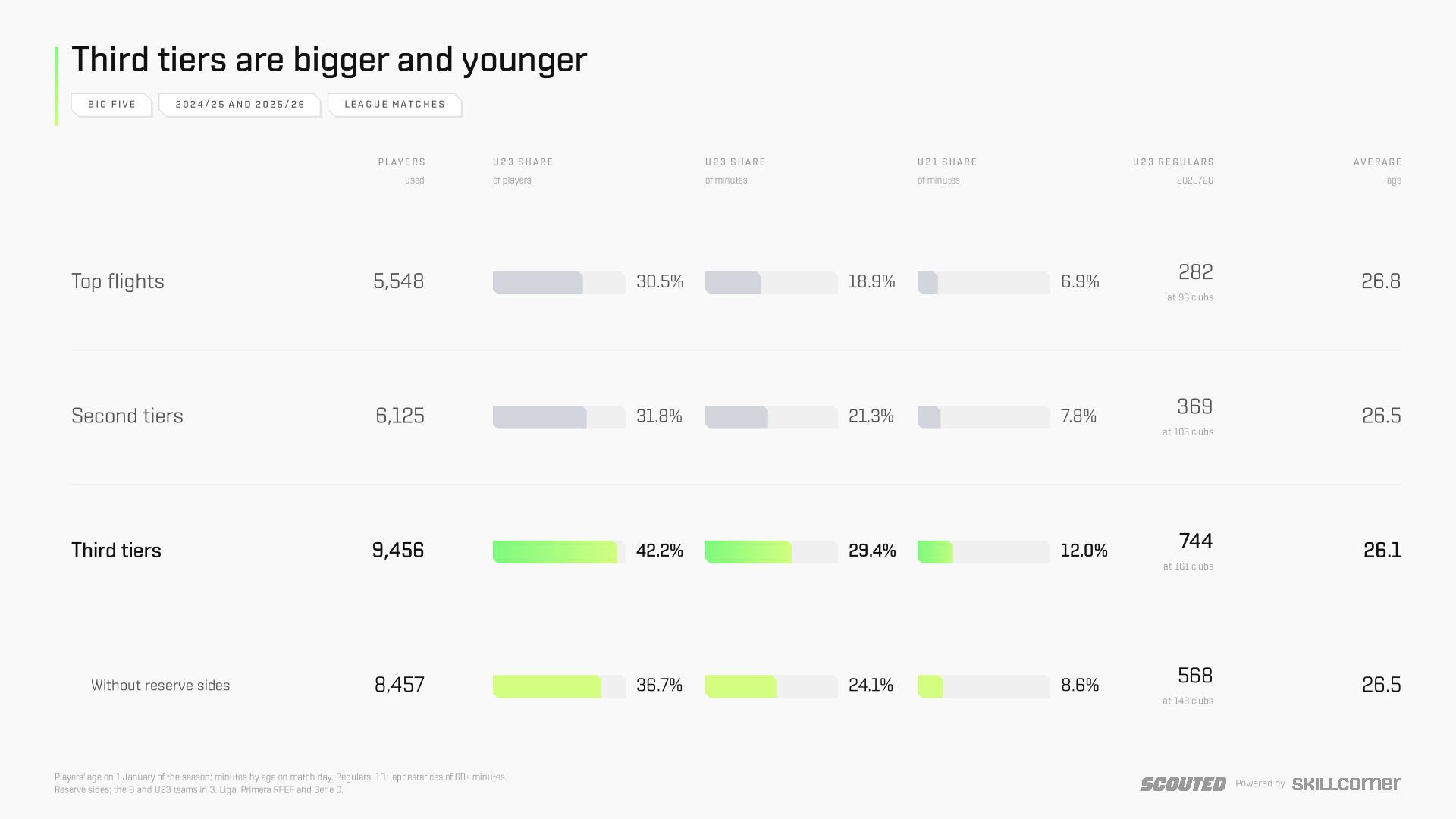
Not only is the share of young players greater, they are exposed to more football. In fact, a general rule for the Big Five Leagues is that the lower down the ladder you go, the more minutes are funnelled into young players. Of course, the reserve sides play a role in this. It bites hardest in Germany and Spain but means practically nothing in Italy and does not exist in England and France; loans do play a role, however.
Looking further into each specific pyramid, England, Germany, Spain and Italy all have a very similar share of minutes for U23 players within their top flights, ranging from 15.7% (Serie A) to 18.8% (Bundesliga). France is an exception.
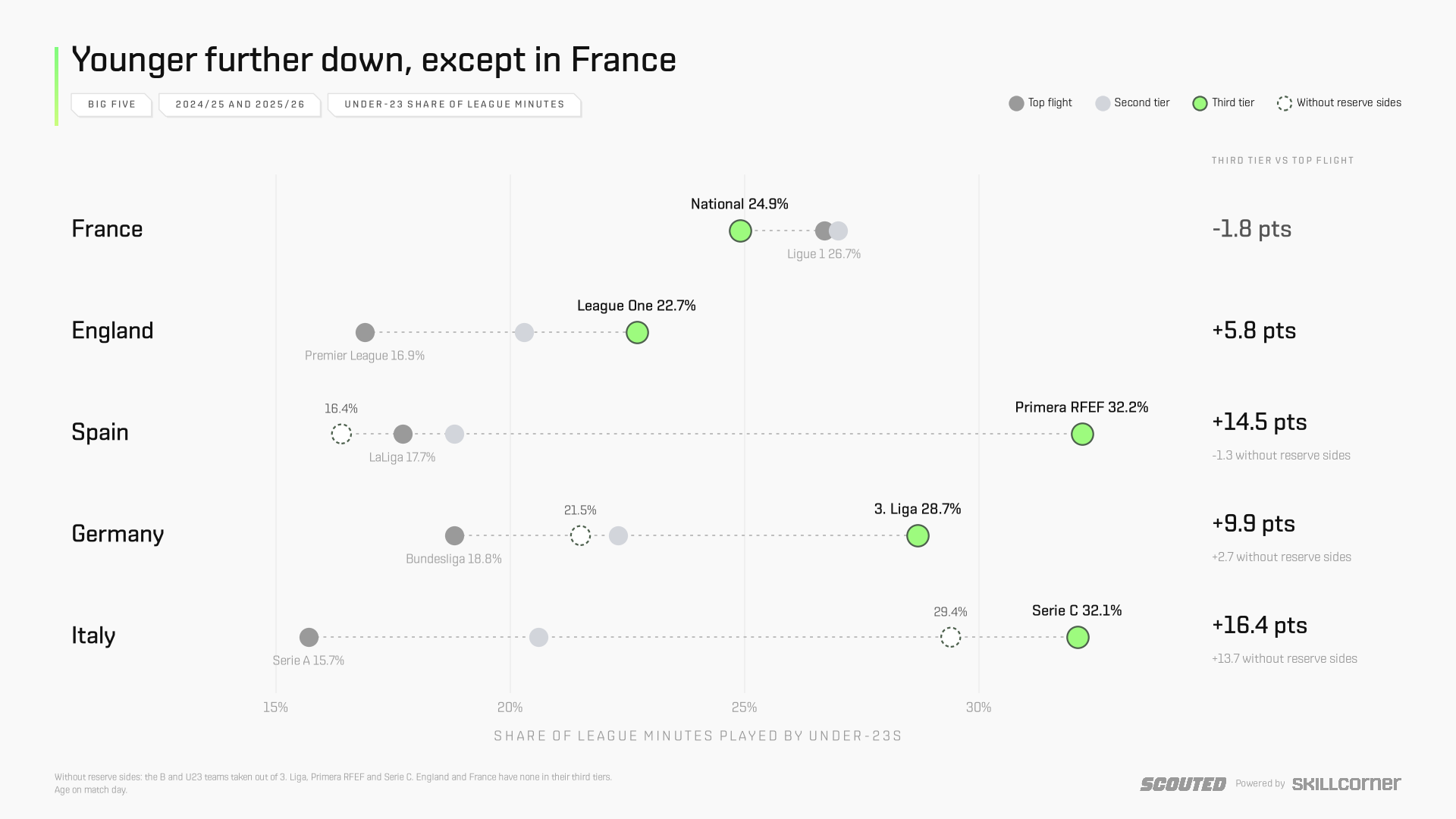
Not only does Ligue 1 rank first when compared to the other Big Five first tiers at 26.7%, it does not follow the general pattern. In France, the trust placed in young players is universal. That’s why it remains the go-to destination when scouting high-potential talent. It ranked first for the estimated net earnings we applauded Belgium for earlier with a staggering €845 million. In France’s case, you’re shopping from a deep pool of young talent whichever rung of the ladder you’re at.

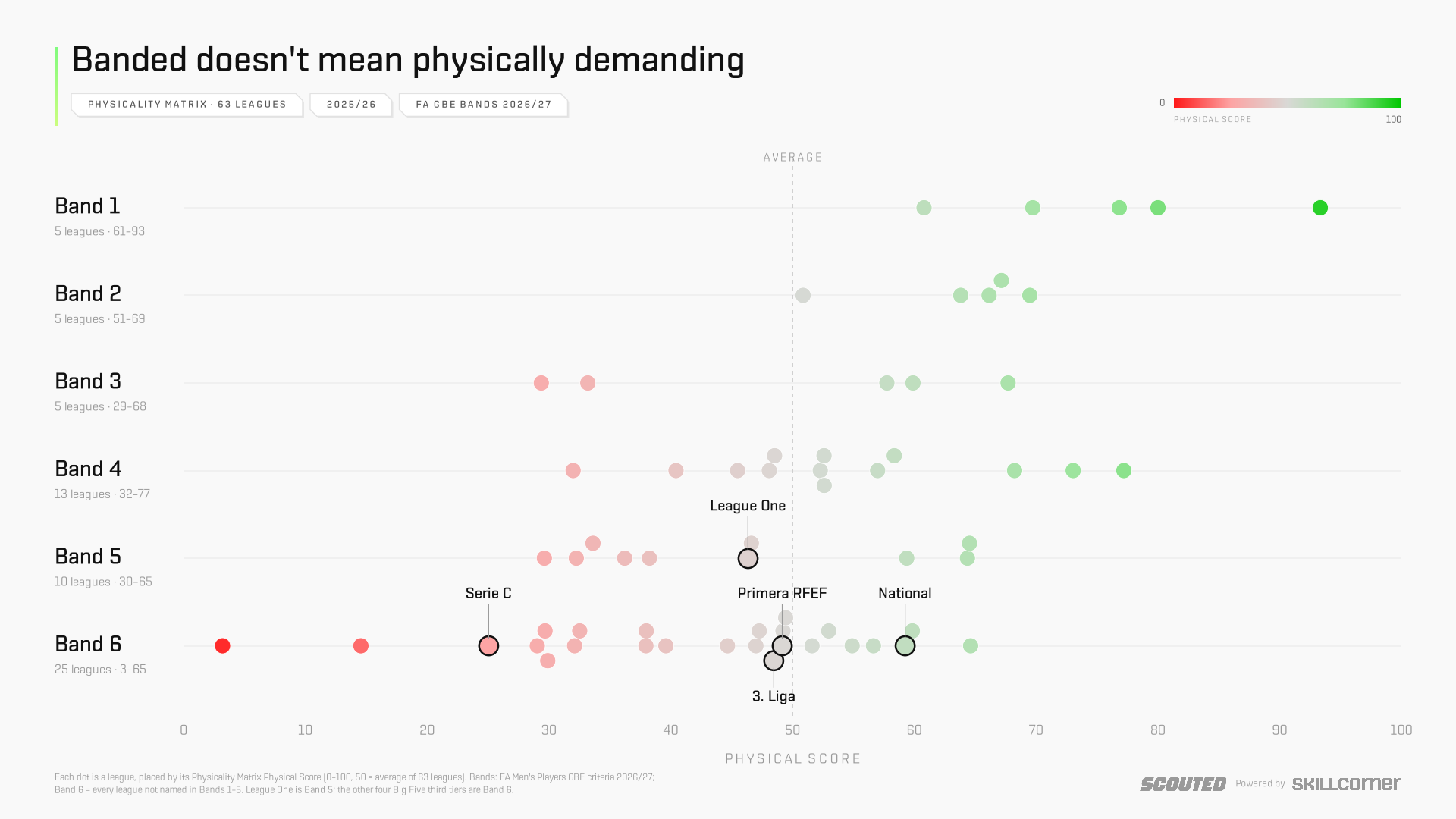
Using the recently developed Physicality Matrix, now expanded to 63 global competitions, helps explain France's ability to generate huge profit. In terms of physical demand, the climb up the French tiers or the jump to another league is less steep. From Serie C, it's massive.
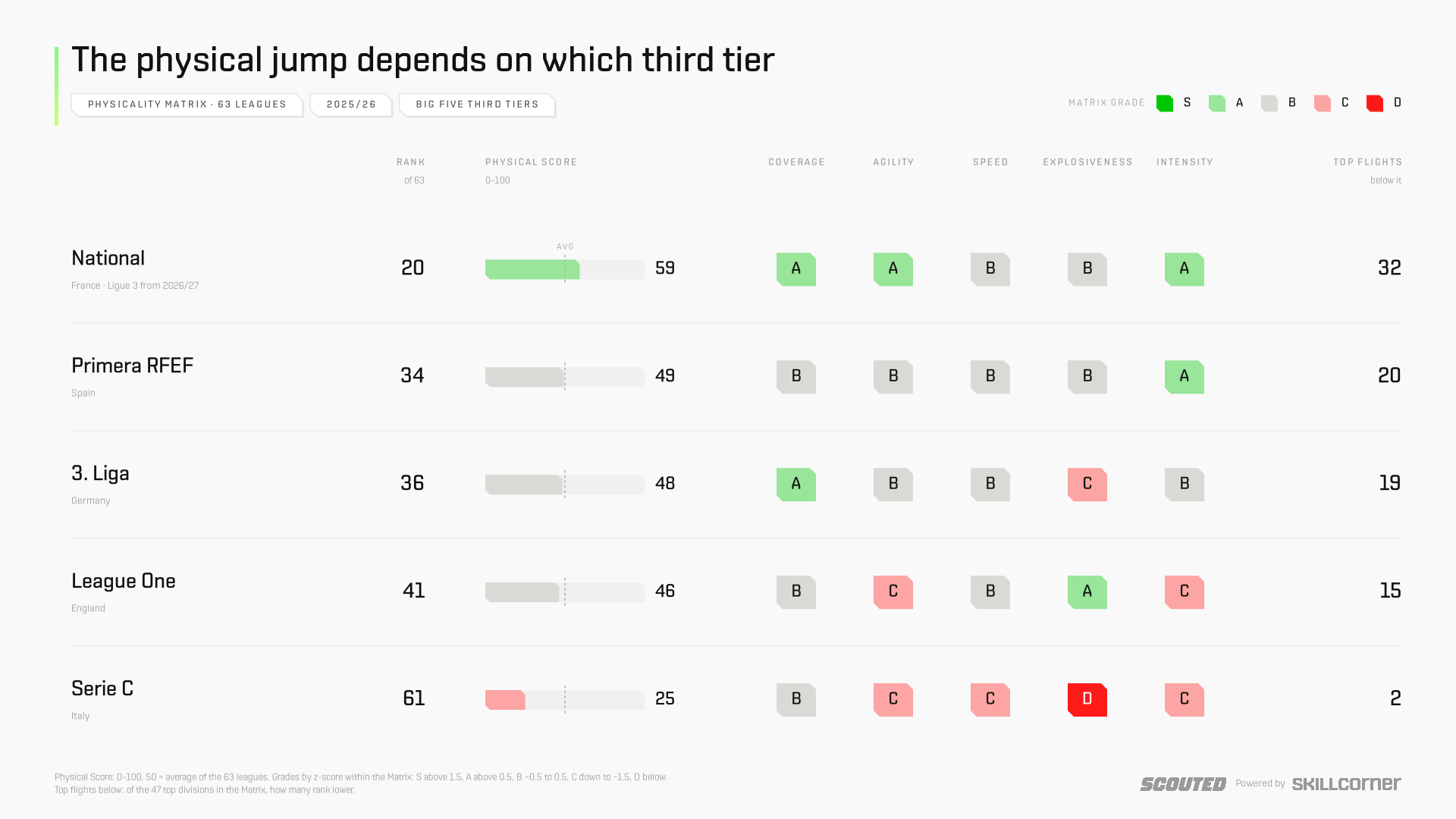
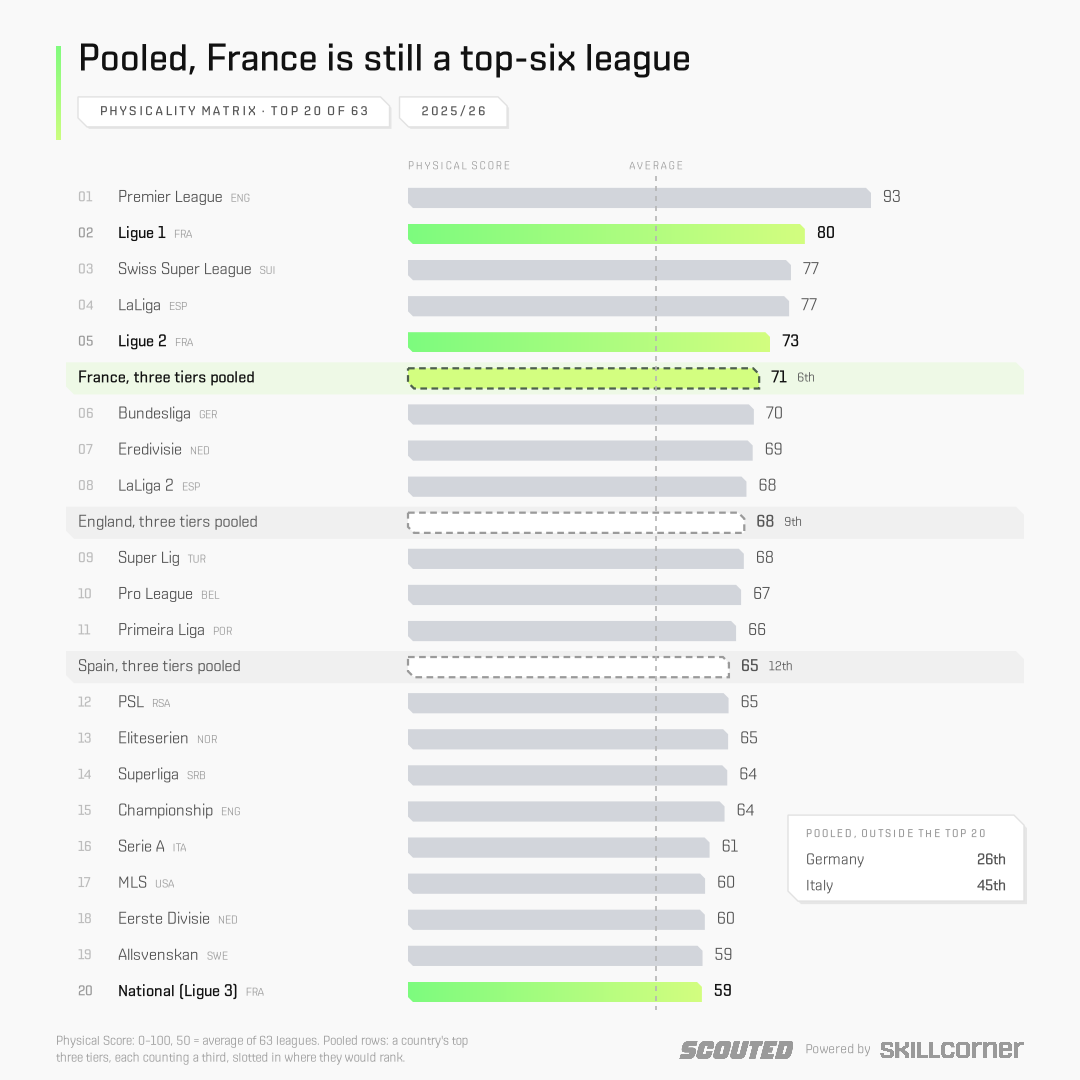
In fact, not only is Ligue 3 (a name change from Championnat National ahead of the 2026/27 season) a top 20 league using our Physical Score, but France once again as a region is remarkably similar across all tiers. If we pool it as a region, it ranks sixth in the table.
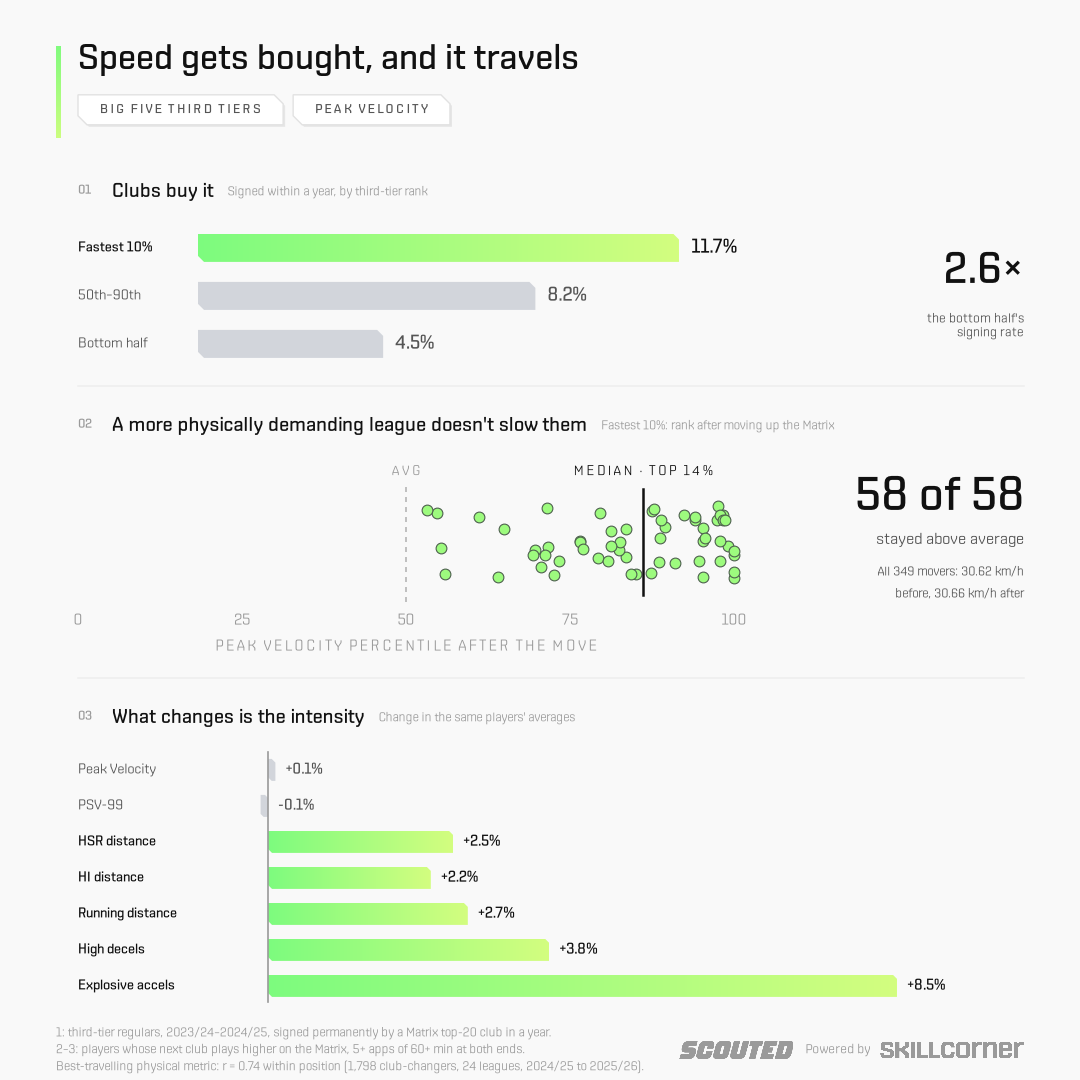
There is one thing that a club can buy from any third tier with confidence: speed.
Using SkillCorner's tracking data, we followed 1,798 players who changed clubs between 2024/25 and 2025/26 across 24 leagues. Within each position, Peak Velocity was the physical metric that best survived the move, and the one a new team shapes least.
Third-tier graduates follow the rule. Clubs buy it, too. Third-tier regulars in the top 10% for Peak Velocity were more than twice as likely as the bottom half to be signed permanently within a year by a club in a Physicality Matrix top-20 league. And the increased physical demand doesn't slow them: all 58 of the fastest 10% who moved to a more physically demanding league stayed above average there, and the typical one ranked in the top 14%. Speed travels.
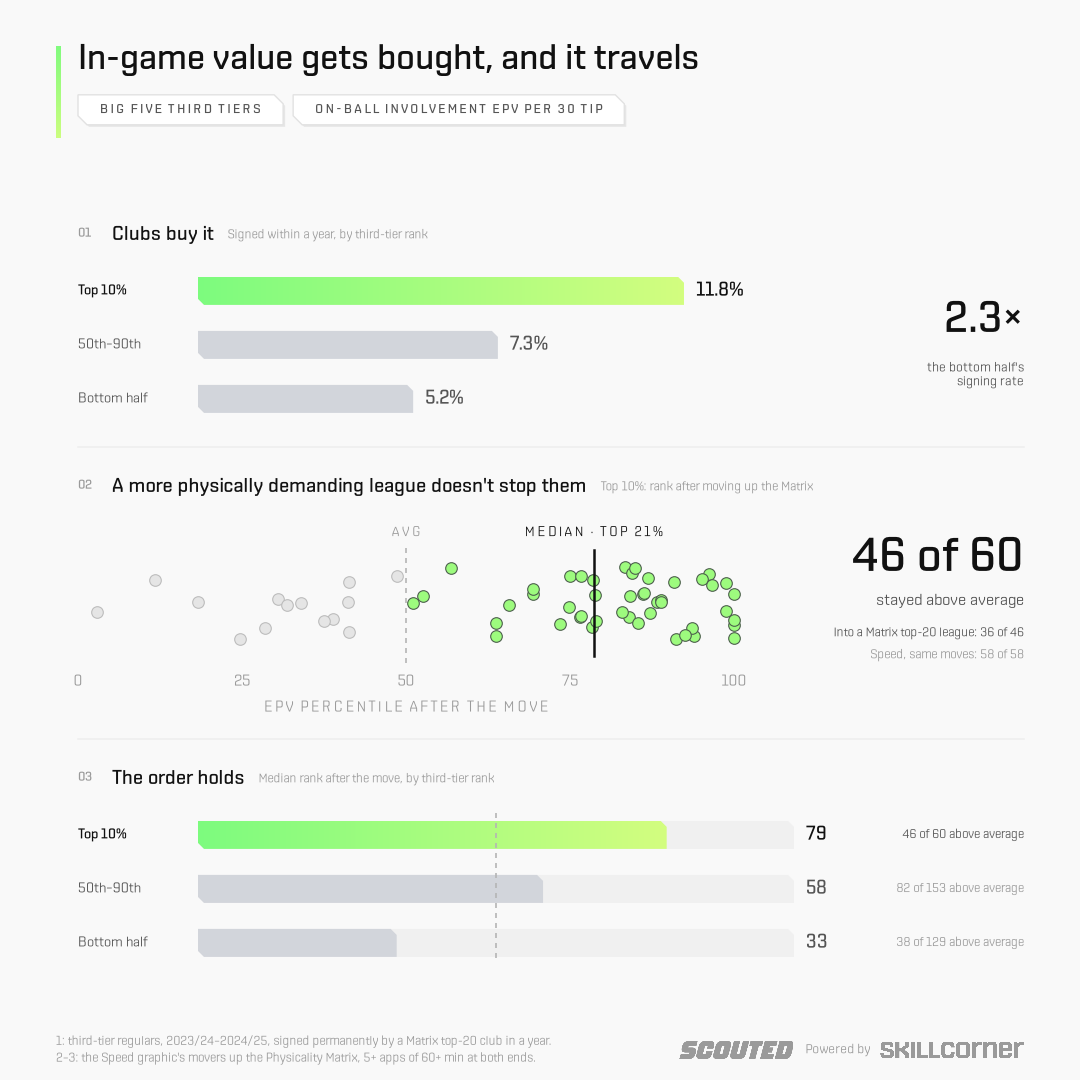
That doesn't make speed the only attribute worth scouting. The players creating the most value on the ball in the third tier survive that physical jump, too. SkillCorner’s Expected Possession Value (EPV), powered by the full context of tracking data, measures the probability of a team scoring within a defined window. On-Ball Involvement (OBI) EPV counts the value a player creates through both carrying and passing, highlighting players that have the biggest impact on the game.
Regulars in the top 10% for OBI EPV were signed permanently by a top-20 Physicality Matrix league club at more than twice the rate of the bottom half. Value on the pitch doesn't travel quite as reliably as speed, but it does not get swallowed up by a more physically demanding league.
They also represent real value off the pitch. Angers paid Épinal €150,000 for Estéban Lepaul in January 2024. A season-and-a-half later, Rennes paid them €13.5m. Now he’s a Ligue 1 Golden Boot winner and a France international. SCOUTED favourite Said El Mala cost 1. FC Köln €2.23m from neighbours Viktoria Köln.
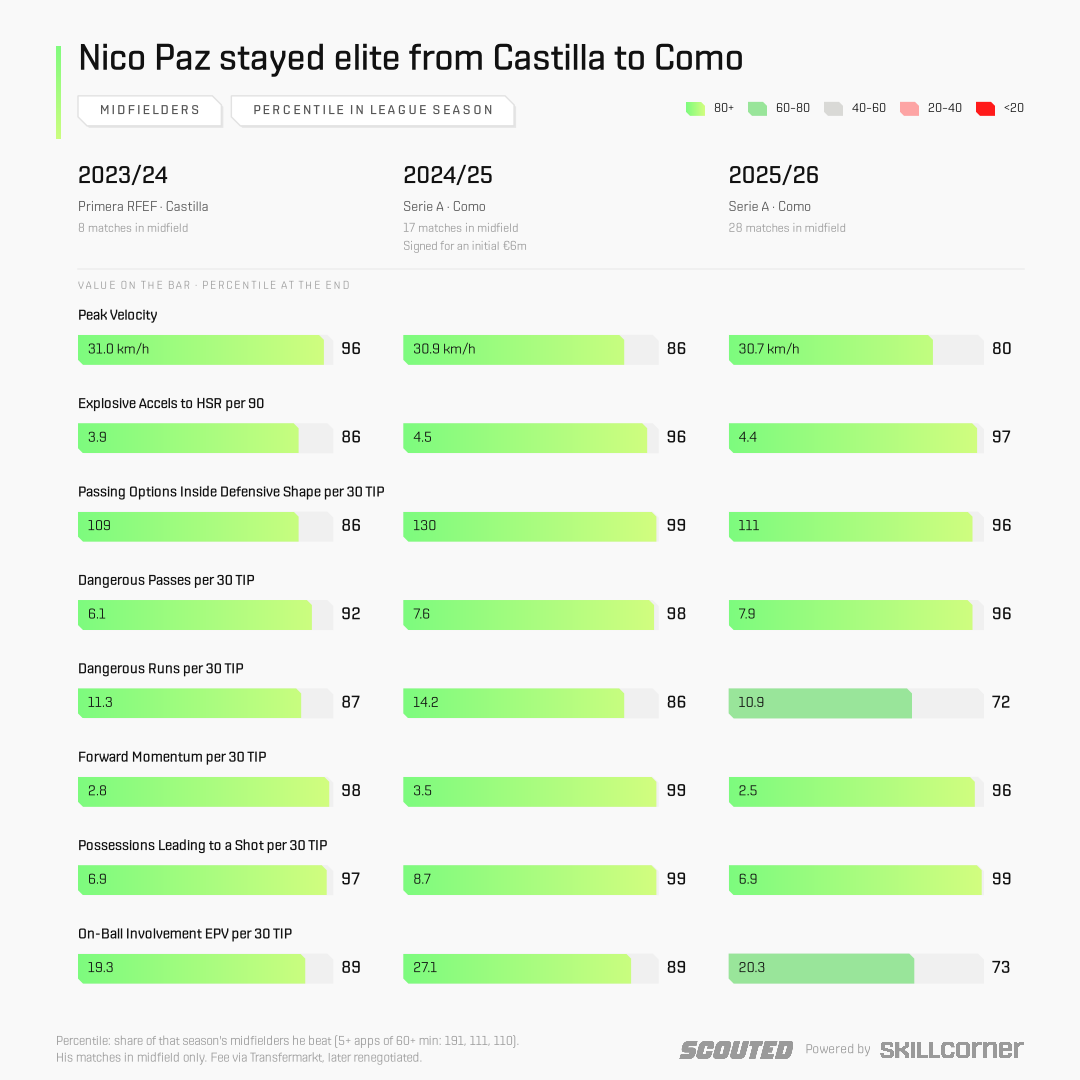
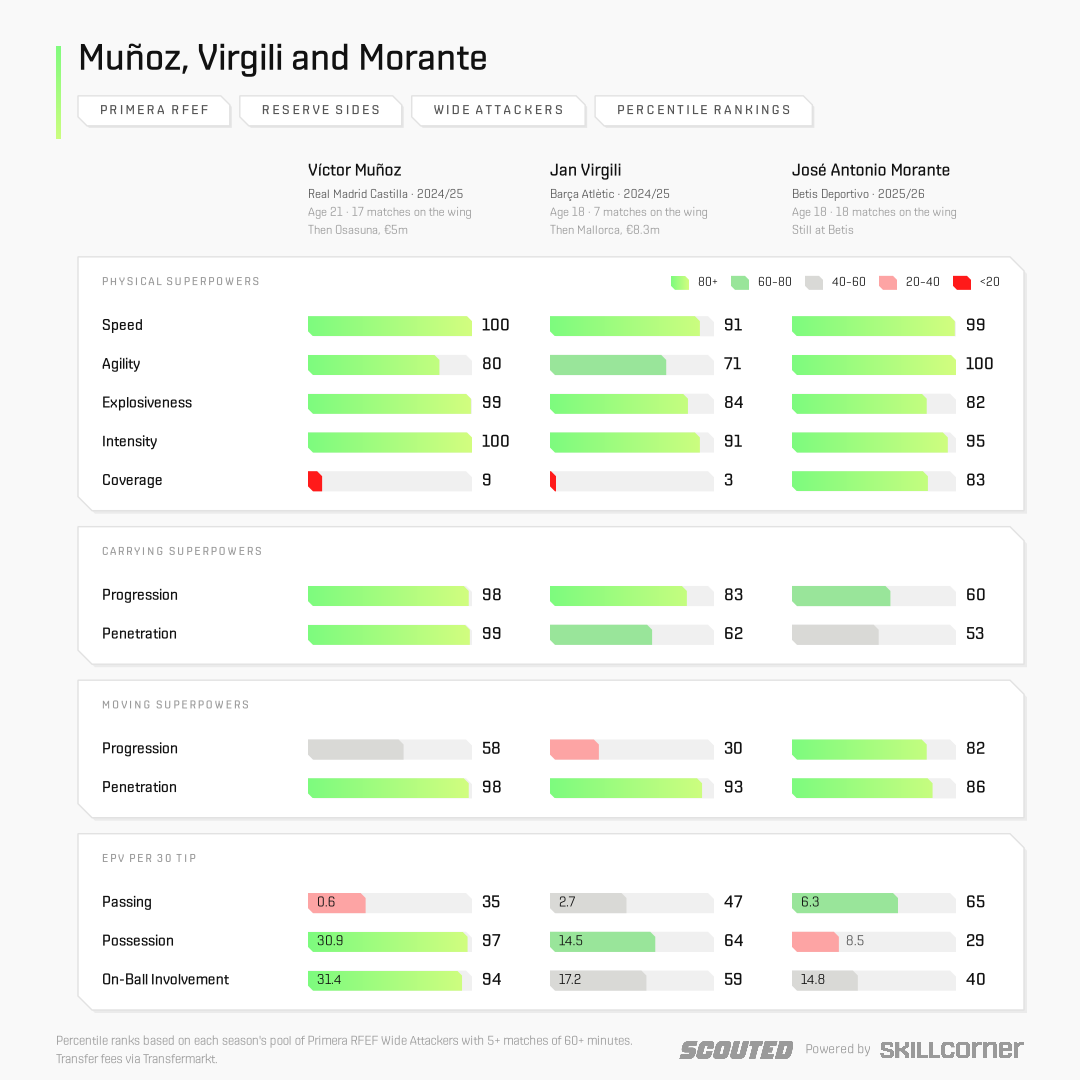
Value is not exclusive to the non-reserve sides, either. Jacobo Ramón left Real Madrid Castilla for Como for €2.5m. Jan Virgili was signed by Mallorca from Barcelona B for €8.3m and then, after one season in LaLiga, was picked up by Club Brugge for €12m. Granted, that price bracket is suited to clubs in that third group established by UEFA - and the senior sides may add buy-back clauses and sell-on fees that aren't visible in the fee - but they are certainly attainable. Even Nico Paz was initially picked up for €6m before Como needed to renegotiate the deal for his full rights this summer, for eleven times the price of the initial fee.
Scouting the third tiers also exposes talent earlier. Johan Manzambi was playing for Freiburg’s reserve side in the third and fourth tier before his breakout year (and World Cup) led to a €60m move to the Premier League. Only the richest clubs can afford the confidence that first-team exposure supplies. For the rest, it’s a calculated risk.
Quantifying that risk is difficult and, as I learned at the most recent Training Ground Guru Live conference, projecting player performance - part of the risk calculation when signing a player - is clearly at the forefront of clubs' minds, and of the services they are investing in.
Unfortunately for some clubs, even if they are aware of this value and are ready to take the plunge, it’s impossible to do so. This is most obvious when looking at the English Football League.
Under the FA's 2026/27 work-permit (GBE) criteria, the Big Five third tiers outside of England all fall into Band 6: an ever-present there earns four of the 15 points a non-UK player needs to be registered. Ligue 2 is Band 4, and five matches there meet the minimum for the under-23 (ESC) route. The effect is stark. Of the 391 permanent signings Championship clubs made between summer 2024 and January 2026 where we know the player's previous league, just one came straight from Ligue 3, 3. Liga, Primera RFEF or Serie C, against 50 from League One and 21 from the Big Five second tiers abroad.
Ligue 2 side Rodez have recognised their role in facilitating access to the full depth of the French pool, and the financial benefit that comes with it. Derek Mazou-Sacko was sold to Millwall after just 12 starts for €500k; he signed for free. Nolan Galves, recently ruled out for the remainder of the 2026/27 season with a knee injury, signed for West Bromwich Albion for €1 million two years after joining from Sochaux, although the fee they initially paid is undisclosed.
For a Championship club, keeping track of the talent bubbling away in Ligue 3 as well as identifying Ligue 2 clubs that provide a route into that talent pool is the move. Waiting for that initial step up is pretty much a necessity, even if bands do not guarantee an increase in physical demand.
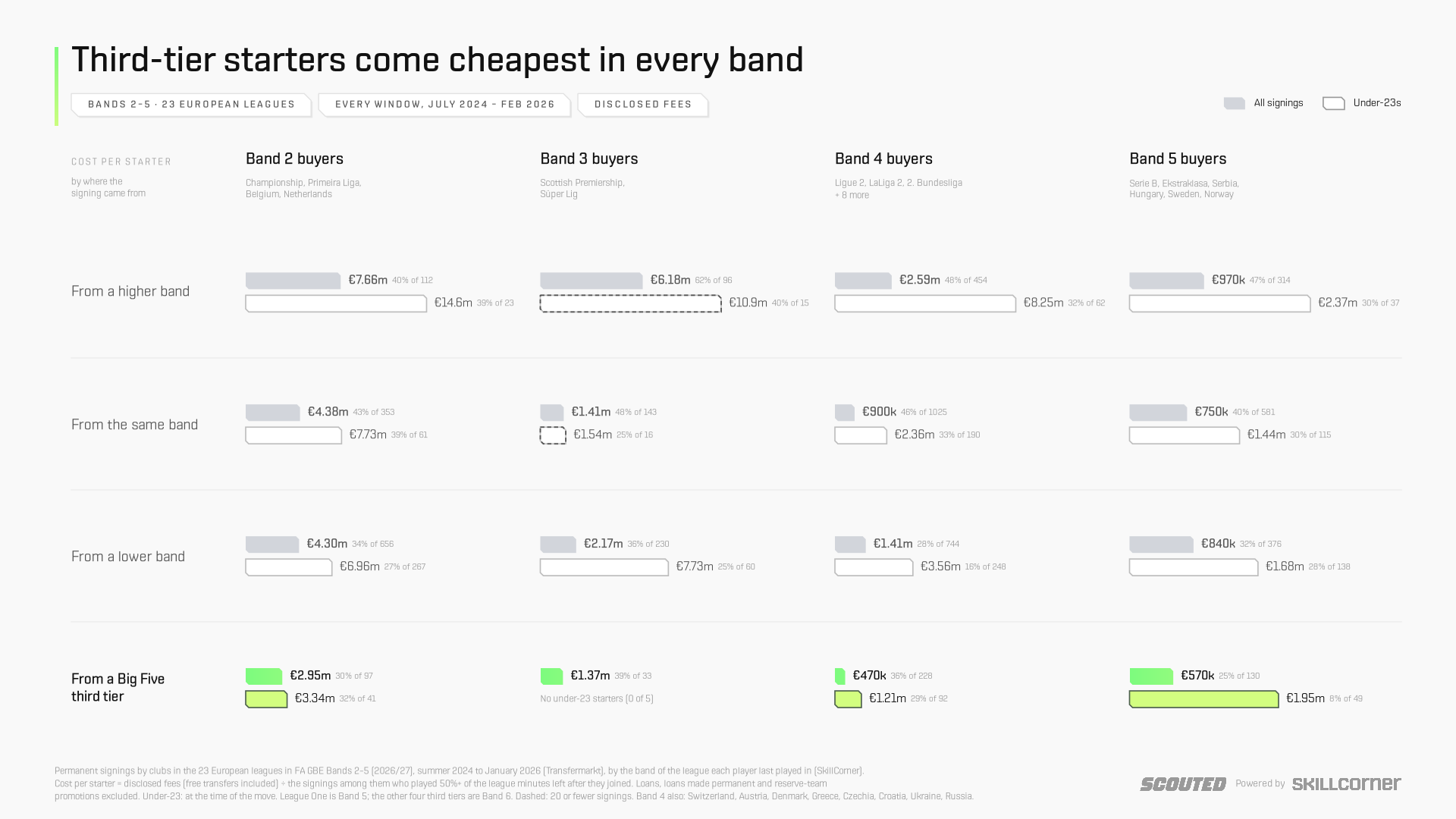
We can, however, put some numbers on this third-tier gamble, as long as we compare like with like: a starter in Ligue 2 isn't a starter in the Premier League. We took every permanent signing made by clubs in the 23 European leagues in work-permit Bands 2 to 5 over the last four transfer windows, grouped them by the buying league's band, and asked two questions:
- Did the player start straight away?
- What did each starter cost?
Unsurprisingly, third-tier signings are the riskier bet. In Band 4 leagues such as Ligue 2, LaLiga 2 and the 2. Bundesliga, 36% started straight away, against 46% of players bought from another Band 4 league. But starters cost more elsewhere, and in every band the third tier was the cheapest place to find one. For under-23s the gap widens: €3.3m against €7.7m from the buyer's own band in Band 2. Even here, youth carries a premium.
But for those with unrestricted access to the third tiers, the advantages are clear:
- The player pool is bigger and younger
- Speed and in-game value can survive a physical jump
- Confidence in starting quality costs less
Using SkillCorner data, we can flag the potential next wave of top-tier talents in the third divisions. Of the 447 under-22 regulars in the five third tiers last season, 179 already matched or beat the Big Five median Peak Velocity for their position.
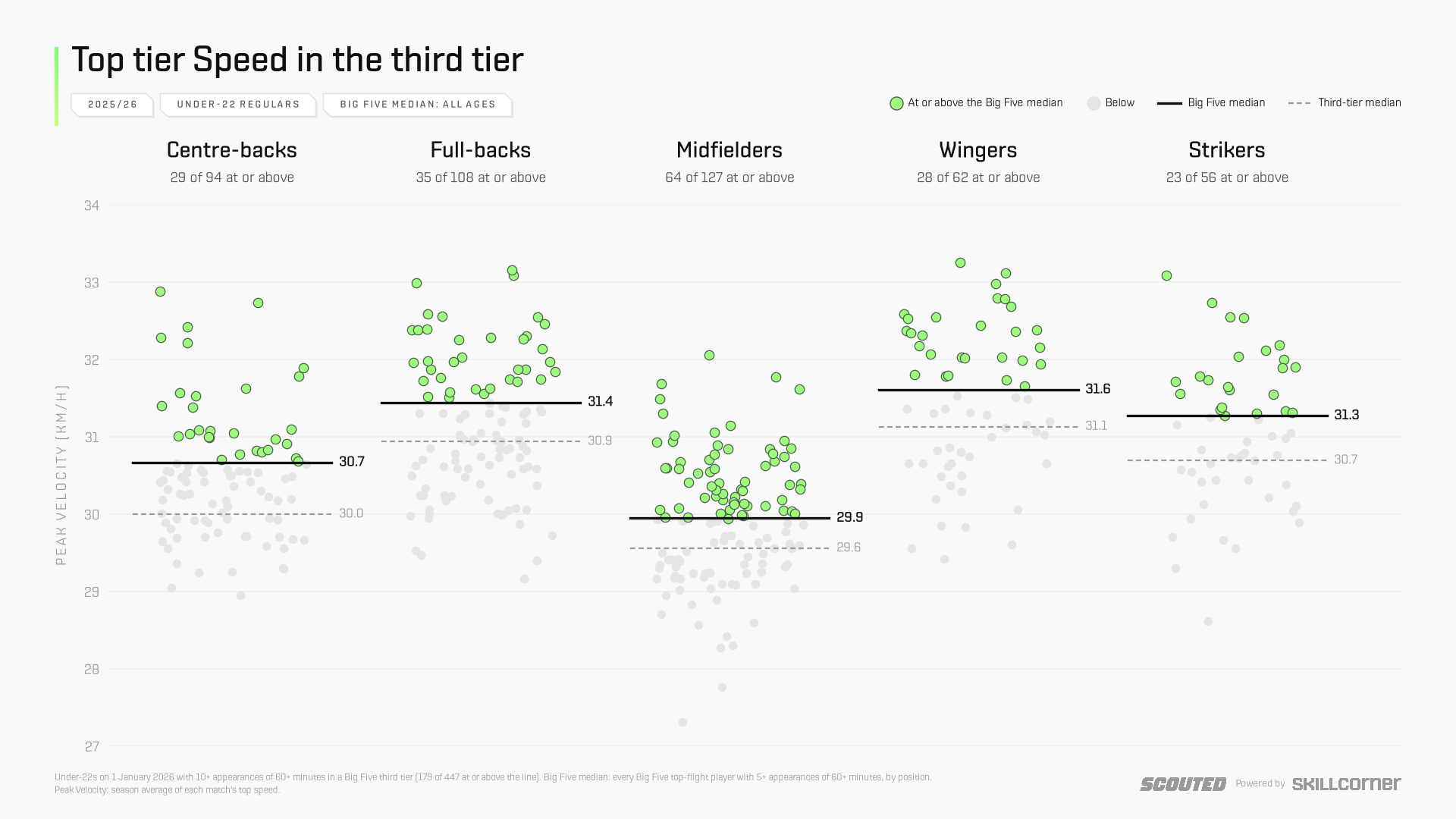
Speed gets a player noticed; the rest of the profile decides the fee. That is why we look at players through the lens of Superpowers and Archetypes, composite Performance Indices that score Physical, Passing, Moving, Carrying and how they behave under Pressure.
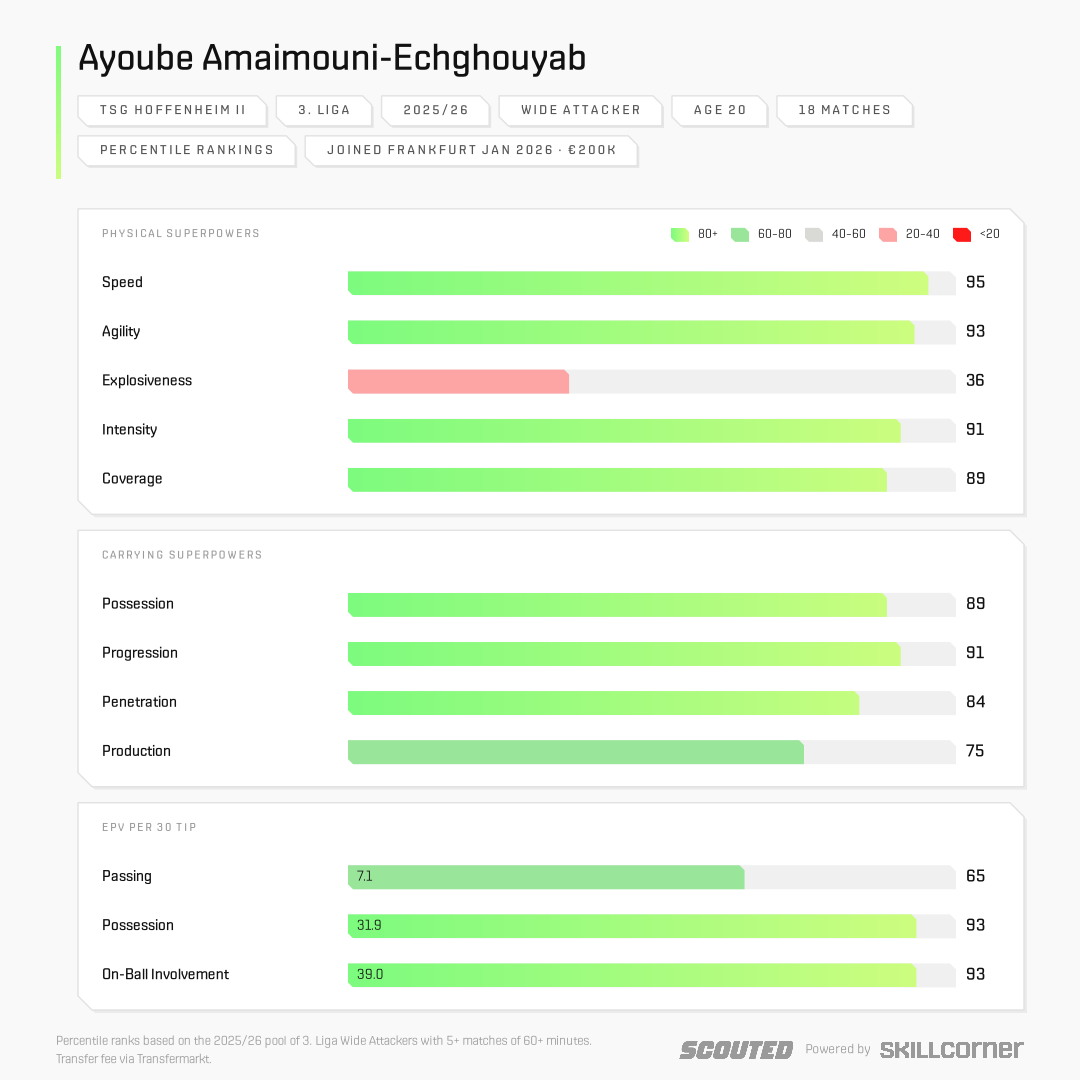
Plenty of standout U23 players across the third divisions in 2025/26 have already made a move. Eintracht Frankfurt paid €200,000 for Ayoube Amaimouni-Echghouyab after he had proven to be quicker than 82% of Big Five wingers when playing for Hoffenheim II.
Paderborn’s consistent investment into the third tier culminated in a return to the Bundesliga for 2026/27. Midway through their promotion season, they paid €550,000 for Kennedy Okpala, 3. Liga’s top-rated striker for Progression through Carrying and under Pressure and quicker than 81% of Big Five strikers.
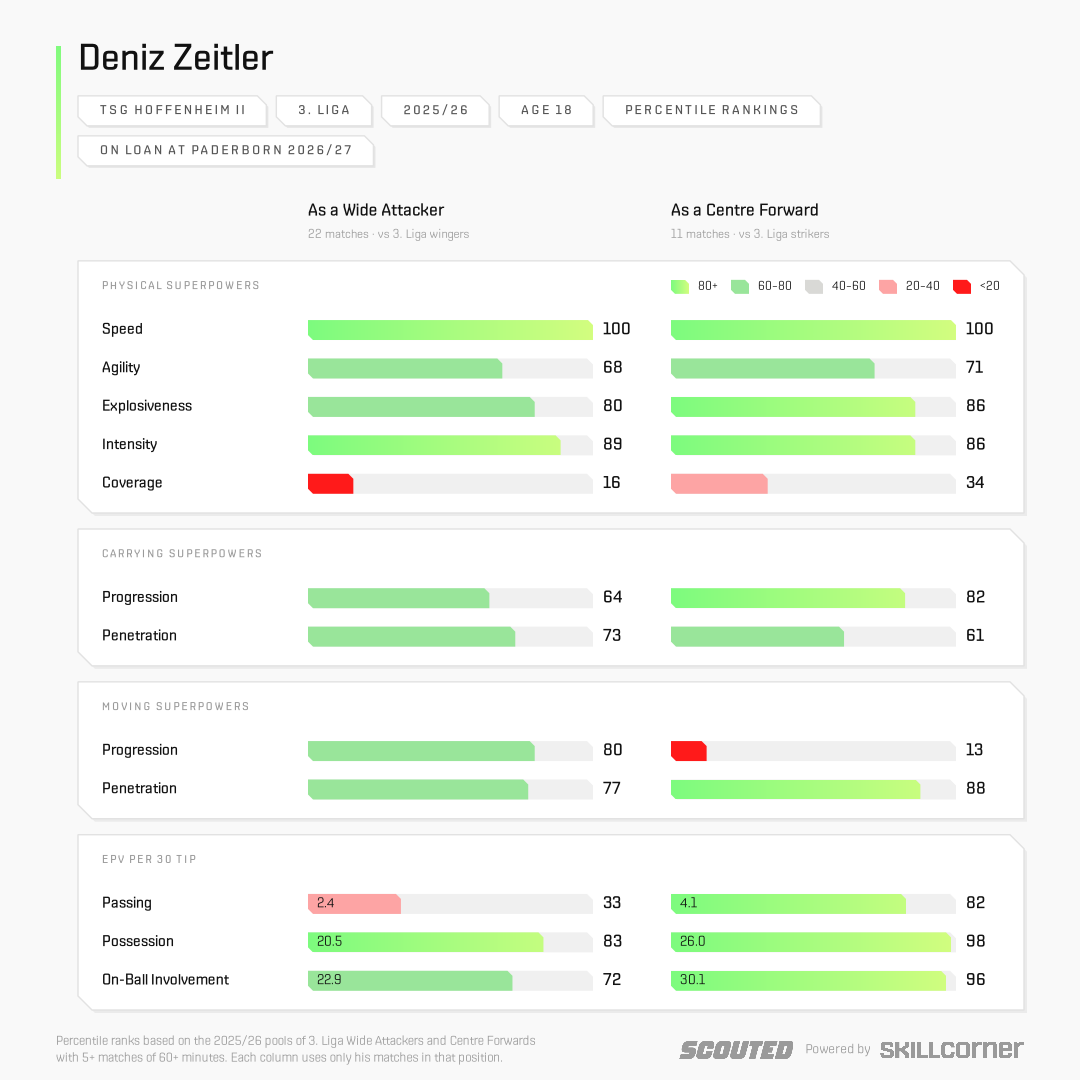
This summer, they took Deniz Zeitler on loan from Hoffenheim. When playing as a Wide Attacker for their reserve side, he recorded a faster Peak Velocity than 86% of Big Five players in that Position Group. When he played as a Centre Forward, only two 3. Liga strikers added more OBI EPV Per 30 TIP.
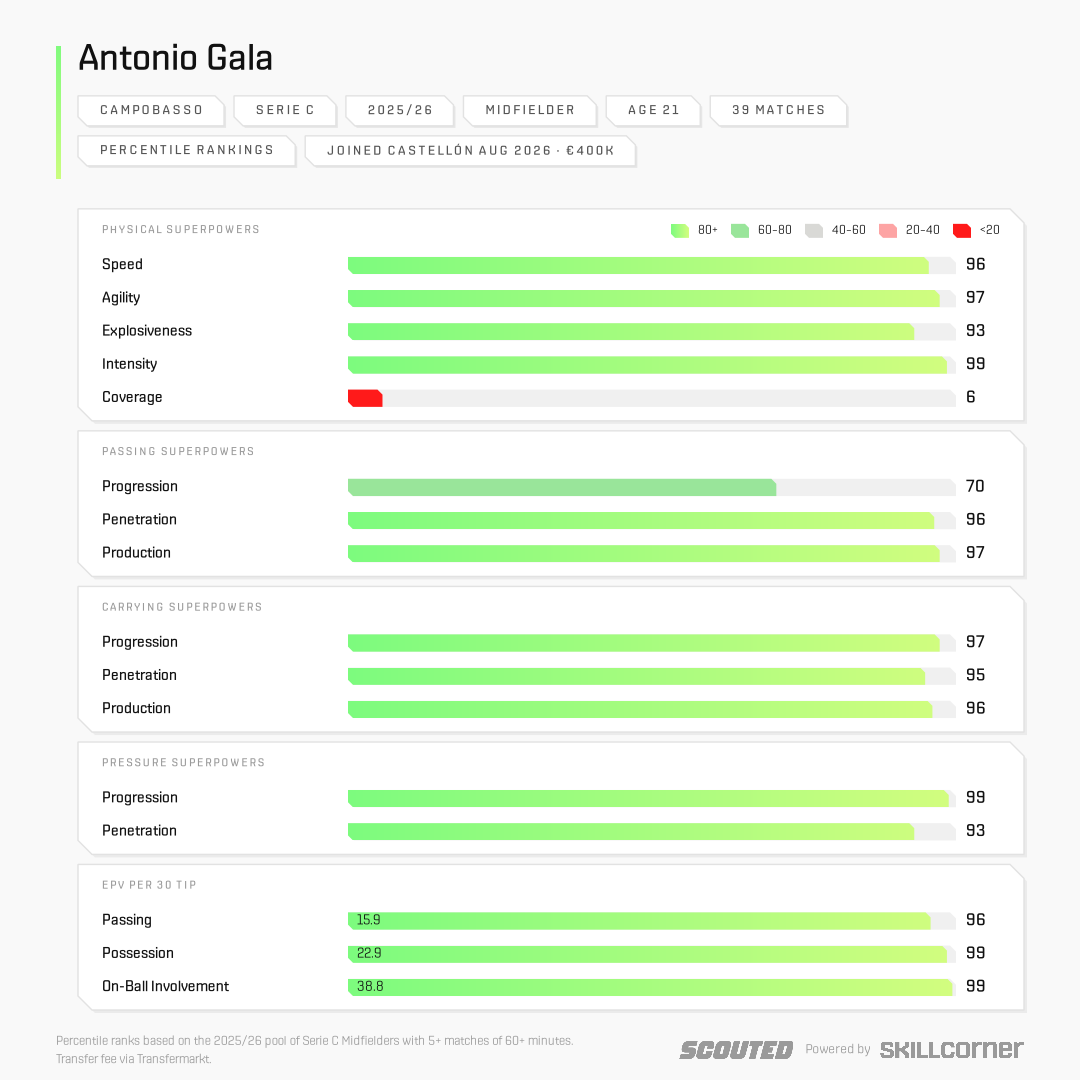
Antonio Gala, in the top 1% for OBI EPV Per 30 TIP, joined Castellón for €400,000. He has more to prove coming from Serie C, but he’s already an outlier in the sense that he’s gone abroad rather than moving up Italy’s internal ladder.
There are a few in League One that have not yet been snapped up. No centre-back in England’s third tier scored higher for Carrying Possession or Carrying Progression than Dylan Lawlor. Now in the Championship with Cardiff, he also recorded a Peak Velocity of 31.1 km/h, quicker than 67% of Big Five centre-backs.
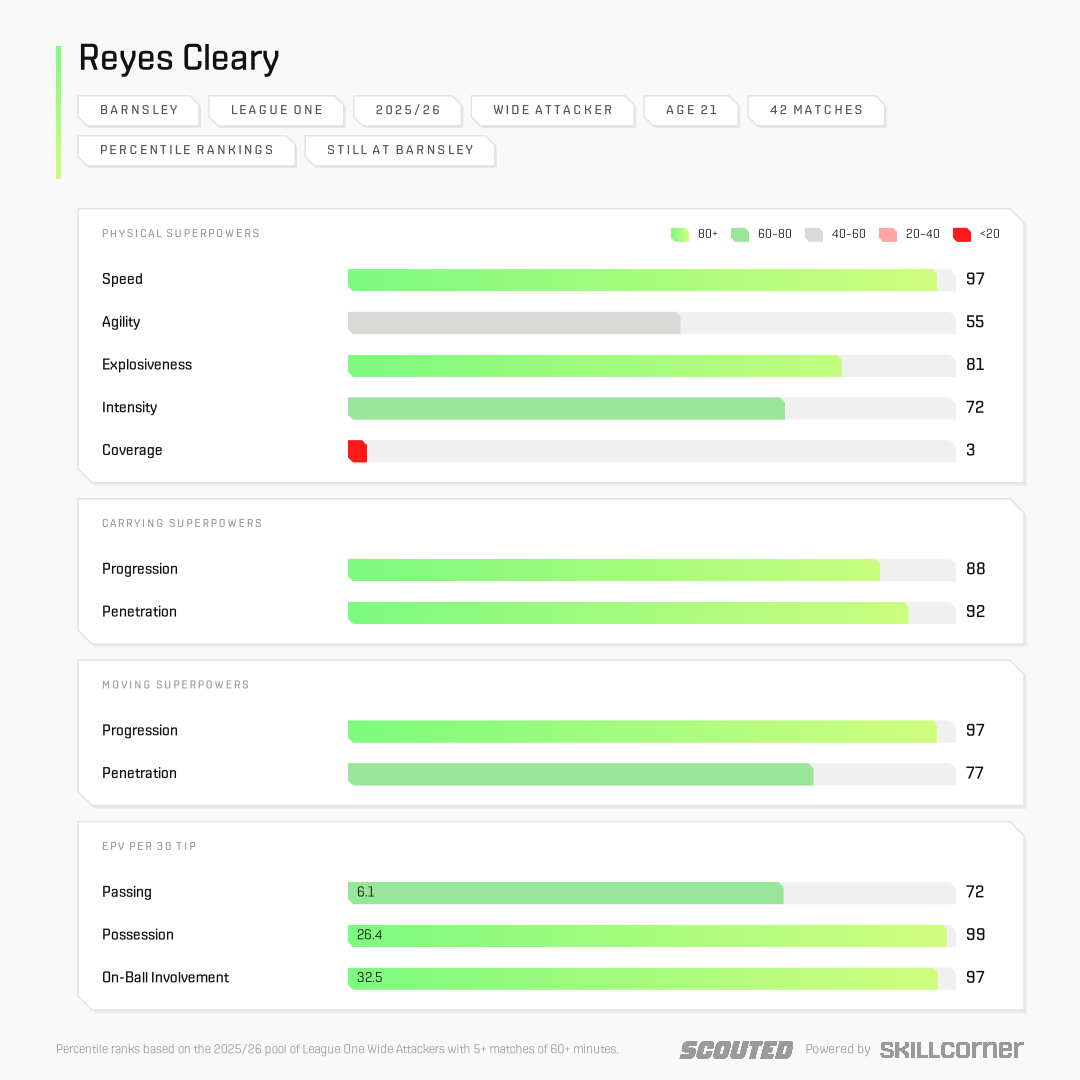
Further up the pitch, Barnsley winger Reyes Cleary ranked third for OBI EPV Per 30 TIP among League One Wide Attackers while his 32.4 km/h Peak Velocity trumped 75% of his Big Five League positional peers.
In Spain, reserve players crowd the Peak Velocity top 10s in particular. But, as we established earlier with Virgili and Ramón, they are attainable. Two of the quickest came from Real Betis' reserve side. Full-back Darling Bladi, quicker than 93% of Big Five full-backs, joined Eredivisie side Heerenveen this summer, but winger José Antonio Morante is still available.
The 19-year-old, who also plays for Betis in the UEFA Youth League, was the third-quickest winger in Primera RFEF last season: his 33.0 km/h Peak Velocity was quicker than 90% of Big Five wingers. Virgili and now-Liverpool winger Víctor Muñoz, who joined Osasuna from Real Madrid for an initial €5m, were also among the division’s quickest wingers before their moves, although, Morante applies his speed to Moving more than Carrying.
Also, if Betis are willing to sell Pablo García, a jewel in their academy crown, for just €3.8m to newly-promoted LaLiga side Racing Santander, then Morante should certainly fall into this cost-effective bracket.
Signing the quickest players, or those creating the most in-game value, from a Big Five third tier league has clear on-pitch and off-pitch advantages. Whether mining that pipeline directly or better positioning yourself to take advantage of their availability when they make a step up to the second tier, it's becoming increasingly valuable to monitor the lower divisions as financial forces fracture the transfer market.

Get in touch today to learn more about how SkillCorner's solutions can help you scout across the tiers with confidence.