


Scouting Wingers Through Explosiveness and Change of Direction Metrics
How explosivity can help to build profile that traditional physical metrics often miss?

Physical data is a central component of modern player evaluation and is often used to describe physical capacity, intensity, and suitability for different competitive environments. Metrics such as running volume and high intensity output offer a useful starting point, but without role specific context or when viewed in isolation, they can be difficult to interpret.
In particular, traditional volume based metrics often fail to capture how players move, overlooking explosiveness and the ability to accelerate, decelerate, and change direction in decisive moments.
This raises a key question for recruitment: how can physical data, combined with explosiveness and change of direction metrics, be used to more clearly separate positional profiles?
In this research, we contextualise physical metrics specifically for wingers. Rather than treating physical output as a one size fits all signal, we explore how different combinations of physical attributes map to distinct winger profiles, and why certain elite players do not align with traditional volume or intensity based assessments. The aim is not to replace established physical metrics, but to refine their application.
With this in mind, we begin by applying a broad physical lens to wingers in the top five leagues.
The scatter plot below positions players by their average output in physical volume metrics, for example Distance per 90 and Average Metres Per Minute (TIP/OTIP) on the x-axis, against high intensity outputs on the y-axis, such as high intensity distance per 90 and sprint output. This provides an initial overview of how winger profiles distribute across differing physical demands.
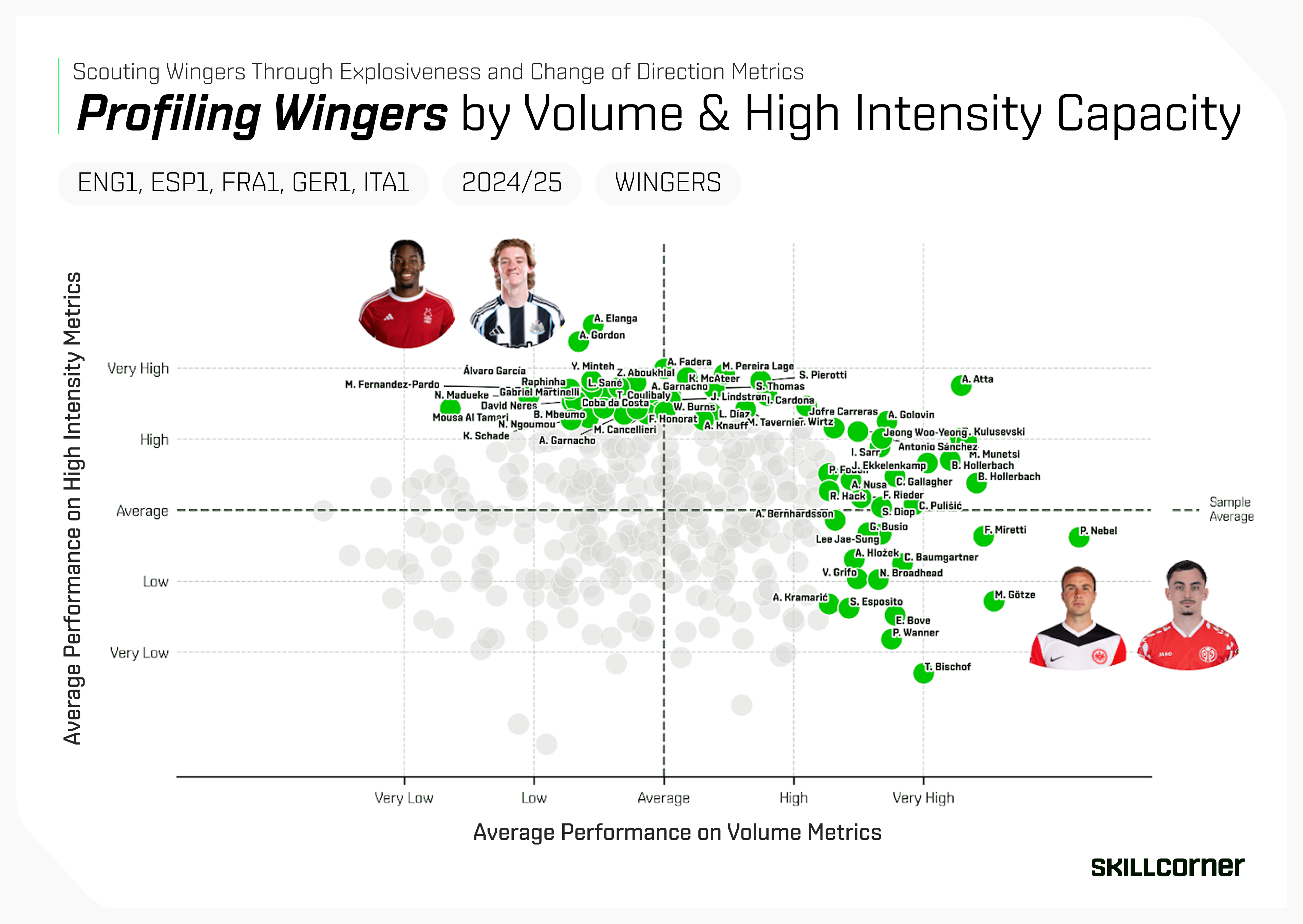
In the bottom right quadrant, we find wingers with high physical volume output. These profiles tend to accumulate large amounts of running but with less emphasis on repeated high intensity actions. Players such as Mario Götze and Paul Nebel fall into this category, profiling closer to midfielders than to classic wingers.
In contrast, the top left quadrant contains players who rank highly for high intensity metrics but do not necessarily accumulate large overall volumes. This group includes wingers such as Anthony Elanga and Anthony Gordon, profiles that are far more direct and typically associated with systems that emphasise verticality, runs in behind, and repeated sprinting actions.
Why Elite Wingers Can Look Underwhelming in Traditional Physical Metrics
However, some notable names are missing from these quadrants. Where do elite wingers like Lamine Yamal fit into this framework?
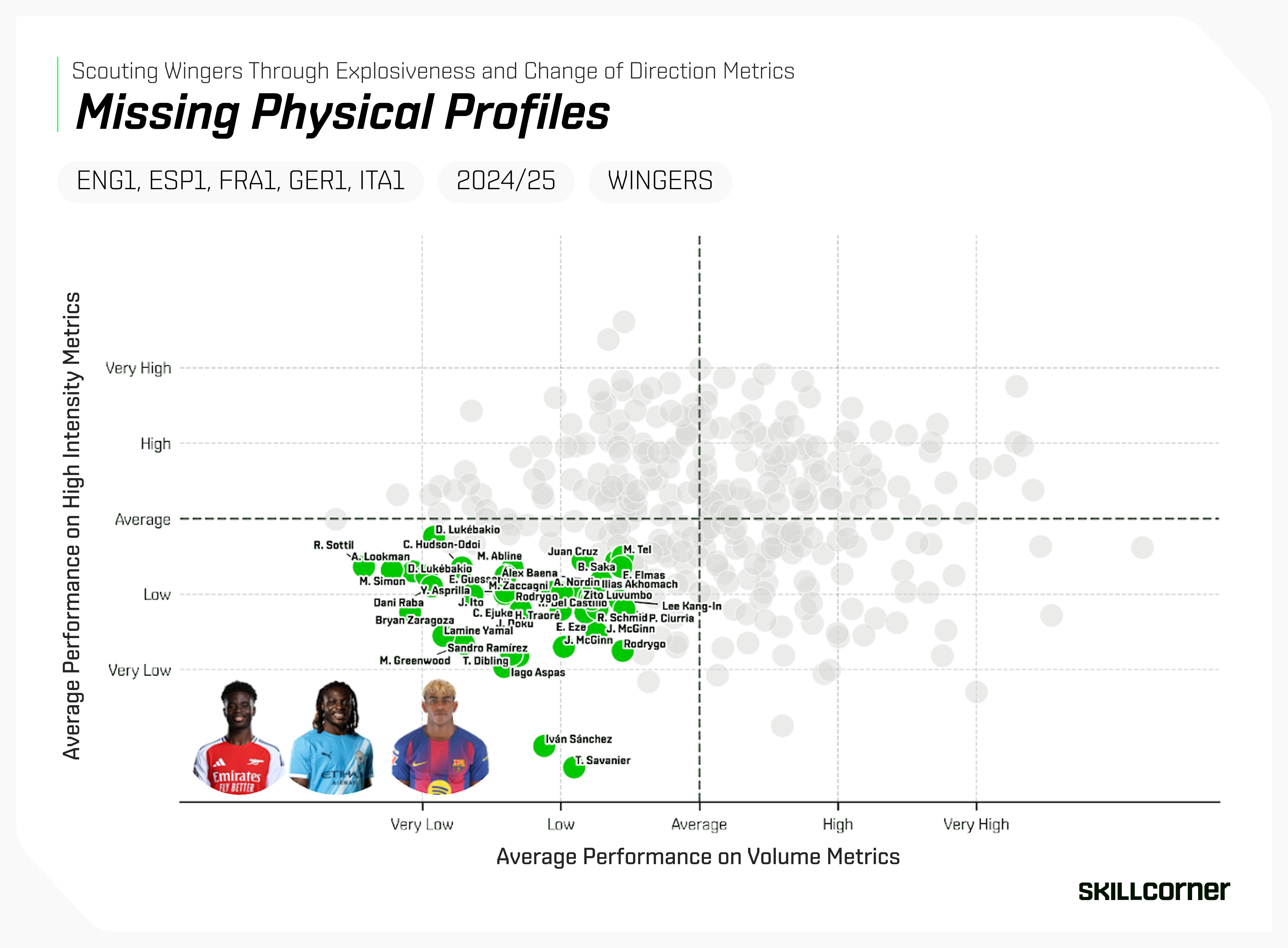
Surprisingly, we find him in the bottom left quadrant alongside other elite players like Bukayo Saka and Jérémy Doku. Based purely on physical volume and high intensity metrics, these players perform relatively poorly.
This raises an important question. Are we missing a key physical dimension that better explains their effectiveness?
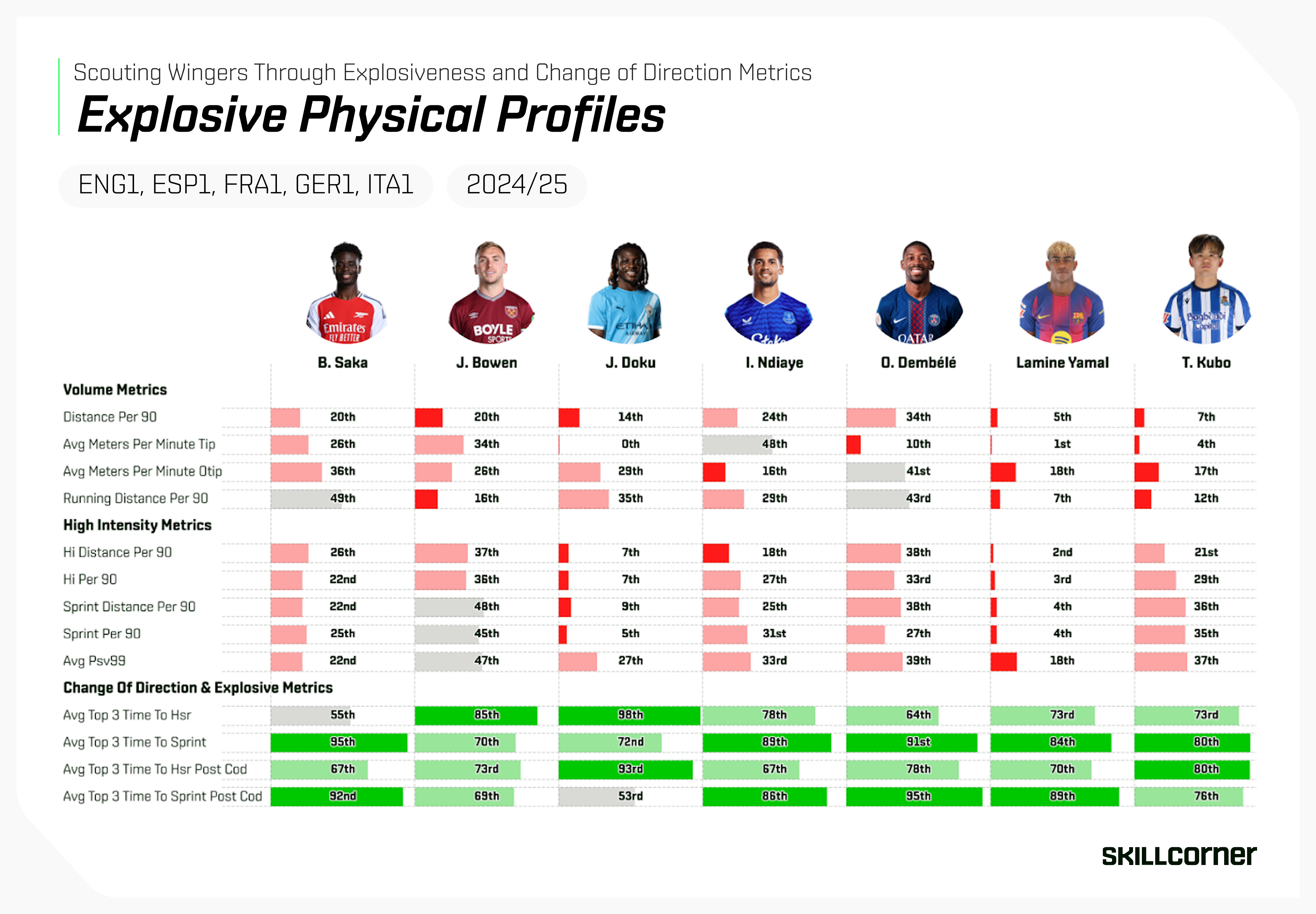
To explore this further, we turn to explosivity and change of direction metrics. The key distinction between the high intensity category and the explosivity category analysed here is that explosivity focuses on time to reach specific speed thresholds rather than pure volume. Instead of how much high speed running or sprinting a player accumulates, we assess how quickly players can reach HSR and sprint speeds, whether from a standing start or following changes of direction.
Explosivity as a Differentiator
The numbers reveal a clear pattern. While these players do not dominate volume or high intensity metrics, they consistently rank highly in explosivity related metrics.
Jérémy Doku ranks in the 98th percentile for Average Top Three Time To HSR, while Saka, Dembélé, and Yamal all place within the top ten percent for Average Top Time To Sprint Post Cod (following a change of direction). These metrics capture how quickly players can accelerate and re-accelerate, including after sharp directional shifts.
This helps explain why these elite winger profiles are so effective in isolated attacking situations. Their threat does not come from sustained running output, but from short, explosive actions that create separation from defenders.
These metrics help contextualise wingers who would not otherwise be identified through traditional volume and high intensity metrics alone.
Refining the Scouting Model
From our research and case study incorporating explosiveness and change of direction metrics into the scouting process, we identified an additional 10 per cent of wingers with elite physical profiles that were not visible through traditional volume based screening alone.
Moreover, around 4 per cent of wingers performed at an elite level across both high intensity and explosiveness metrics, forming a small but highly interesting group of physical outliers and a potential high upside scouting pool.
These insights allow us to refine how we scout agile and explosive wingers. Rather than relying solely on physical volume metrics, we combine high intensity outputs on the x-axis with explosiveness metrics on the y-axis to better separate and contextualise winger profiles.
We have also expanded the scouting pool to include the “next five” leagues.
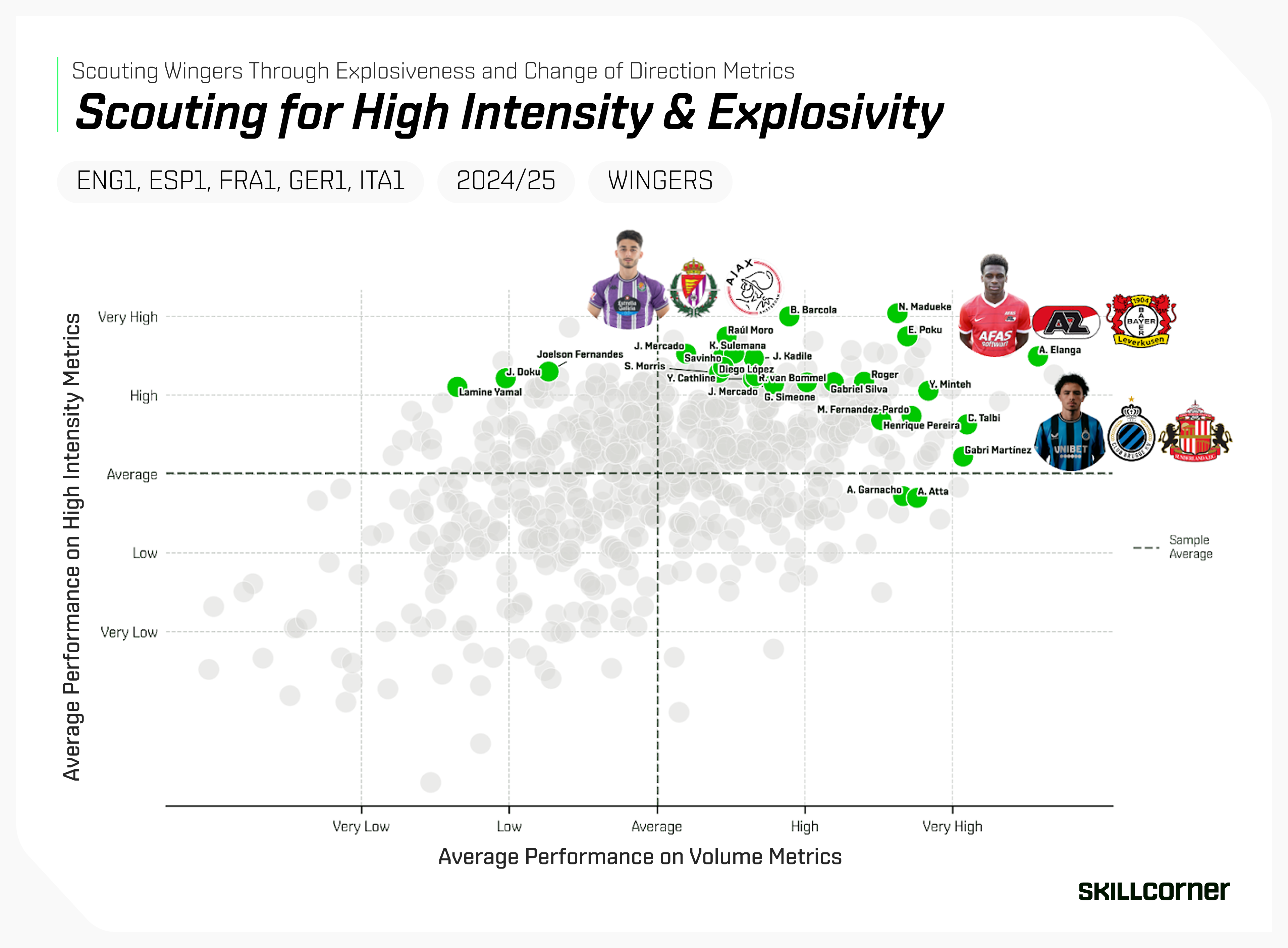
In the top right quadrant, we now identify players who combine frequent high intensity actions with strong explosive capabilities. These are profiles that can repeatedly perform demanding actions across a match while still retaining the agility needed to win one versus one duels.
This group includes familiar names such as Antony Elanga, Noni Madueke, and Yankubah Minteh, but also highlights emerging profiles from the next five leagues. Examples include Raúl Moro, Ernest Poku, and Chemsdine Talbi, all of whom earned moves to new clubs after last season.
This approach illustrates how adjusting the physical lens can uncover different winger profiles and reduce the risk of overlooking elite profiles whose value lies in explosivity and the ability to quickly accelerate out of directional changes.