


Contextual Scouting: The Art of Complementary Squad Building (2/2)
This article explores how to build a complete starting XI using positional profiles and SCOUTED archetypes. The aim is to identify young talent from emerging markets and combine players whose qualities complement each other to form a balanced, cohesive team.
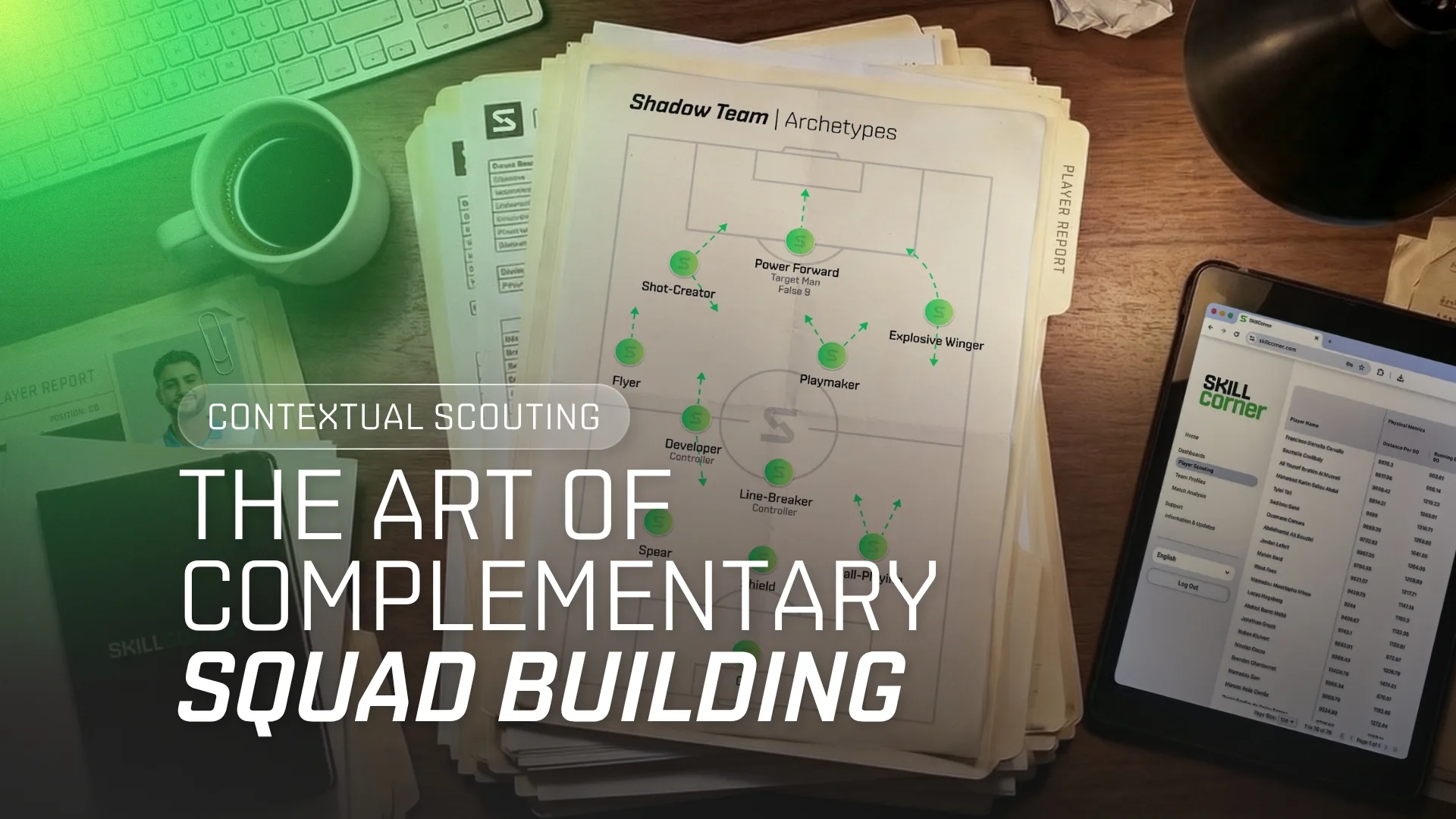
In the first installment of complimentary squad building, we focused on identifying suitable defenders and midfielders.
.png)
In this second part, we will complete the squad by scouting attacking players.

Scouting for Wingers
The first wide attacker we’re looking for is the explosive winger. Our recent case study, Scouting Wingers with Physical Data, revealed that many elite wingers don’t stand out in the data when using traditional volume or high-intensity metrics. What sets them apart is instead explosivity and the ability to change direction quickly. Using explosivity as a proxy, we can identify wingers who thrive in 1v1 situations and create real impact on the flanks.
Below, we highlight several wide attackers (U25) from the 24/25 season who scored above average in explosivity-related metrics last season:
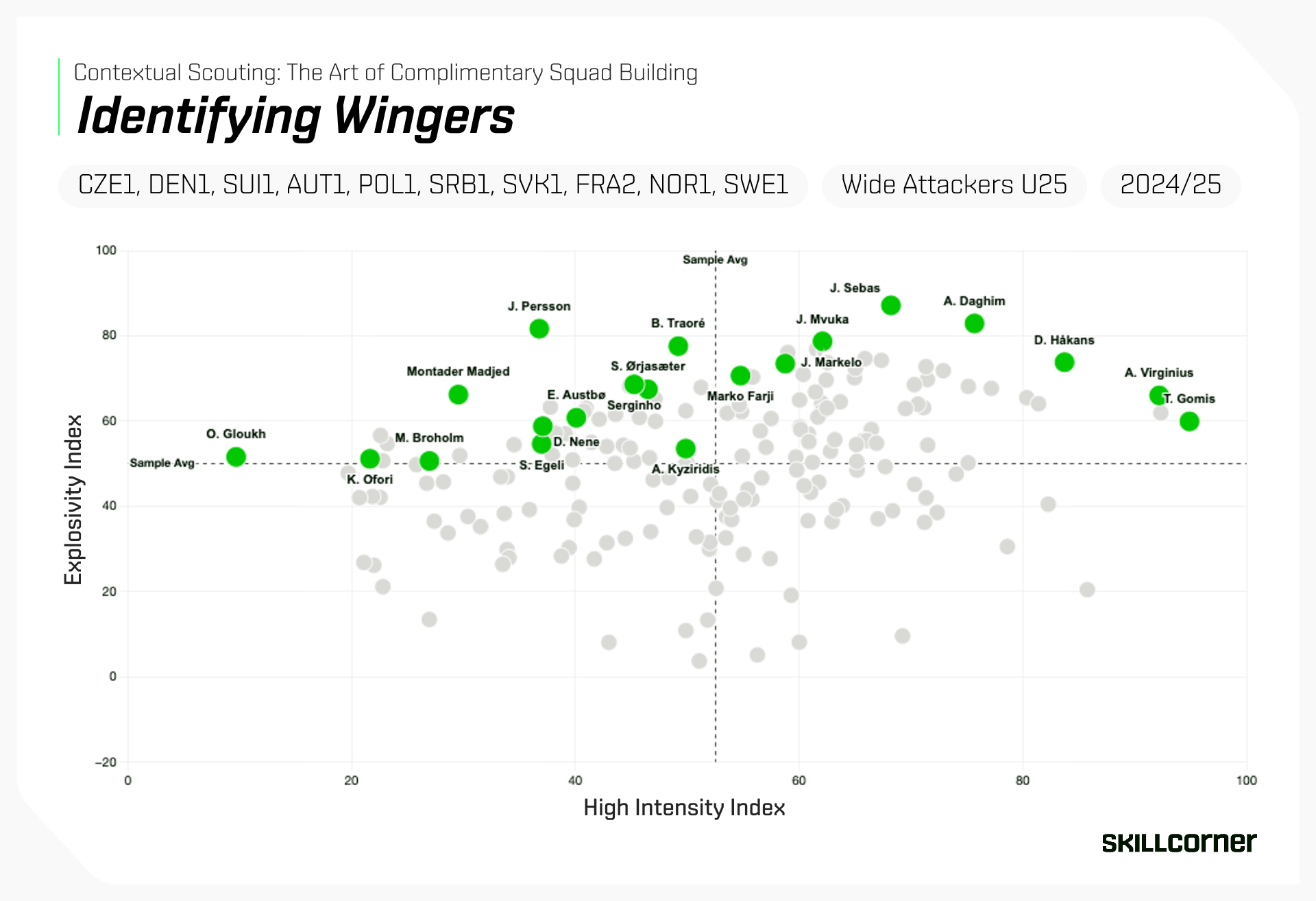
Many of the players we’ve highlighted have already moved clubs after last season, with a few promising talents remaining on our shortlist. We will continue to monitor two right wide attackers in particular: Montadar Madjed (Hammarby) and Jeremy Sebas (SC Bastia).
We have now identified wingers based on their physical profiles - an effective tool of identifying them in the first place. However, we are also interested in seeing which wide attackers excel in creating shots for their teams.
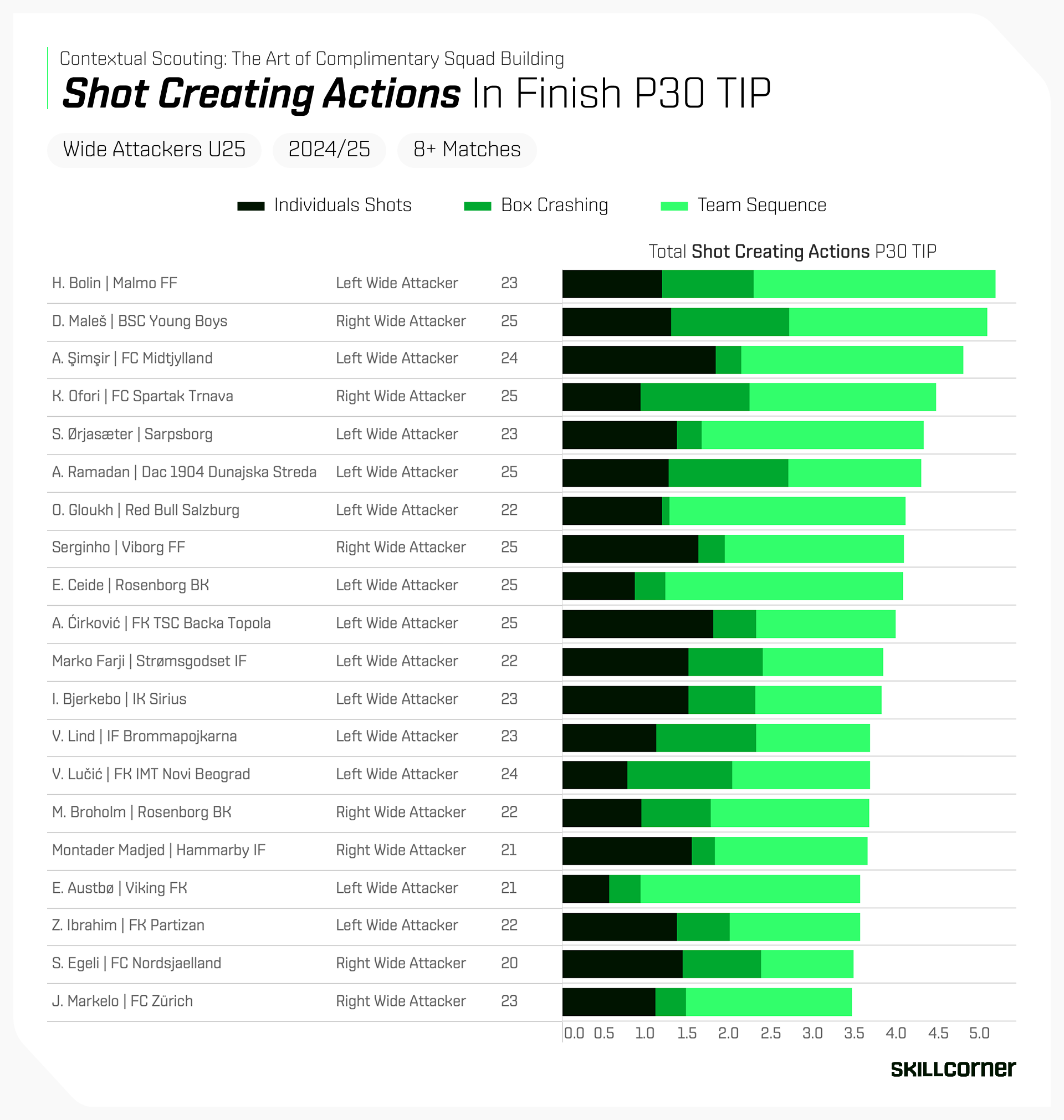
Viewing the two charts together, we have identified Montader Madjed as an option for our right wing. He ranks highly for explosiveness and sits among the top 20 shot creating wingers in our sample. Stylistically, he produces 1.55 shots per 30 TIP from carries that end in individual shots, underlining his ability to turn possessions into direct shots.
On the opposite flank, we are targeting Edwin Austbø (21 in December) and recently named Young Player of the Year in the NOR1 Eliteserien, winning the league with his boyhood club. His profile is more geared towards shot creation through carries ending in passes and crosses (team sequence), which complements our left side dynamic of a shot creating winger, a flying full back, and a developing midfielder.
Given the competition for profiles like these, we are also monitoring Marius Broholm, now at Lille, and Hugo Bolin, now at Borussia Monchengladbach. Should they struggle for consistent playing time, a loan move could be realistic, particularly since we can offer a clear pathway and guaranteed minutes.
Finally, we will also try to join the race of signing Aral Simsir at FC Midtjylland. With 8 goals and 13 assists this season, he offers both end product and versatility in our attacking lineup.
Scouting for Strikers
The final position we are looking to strengthen is centre forward, and we are targeting two distinct striker archetypes.
First, a direct runner who consistently threatens in behind, stretches the back line and creates depth in our attacking play. Second, a traditional target man who can offer a strong physical presence in the box, attack crosses and provide a focal point against low blocks when space is limited.
For the first profile, we are revisiting SCOUTED’s earlier piece where they profiled the Power Forward - inspired by Viktor Gyökeres. This is an archetype that combines a majority share of runs in behind as their main off ball run type with pure speed and athleticism which we can measure with PSV-99 (peak speed velocity):
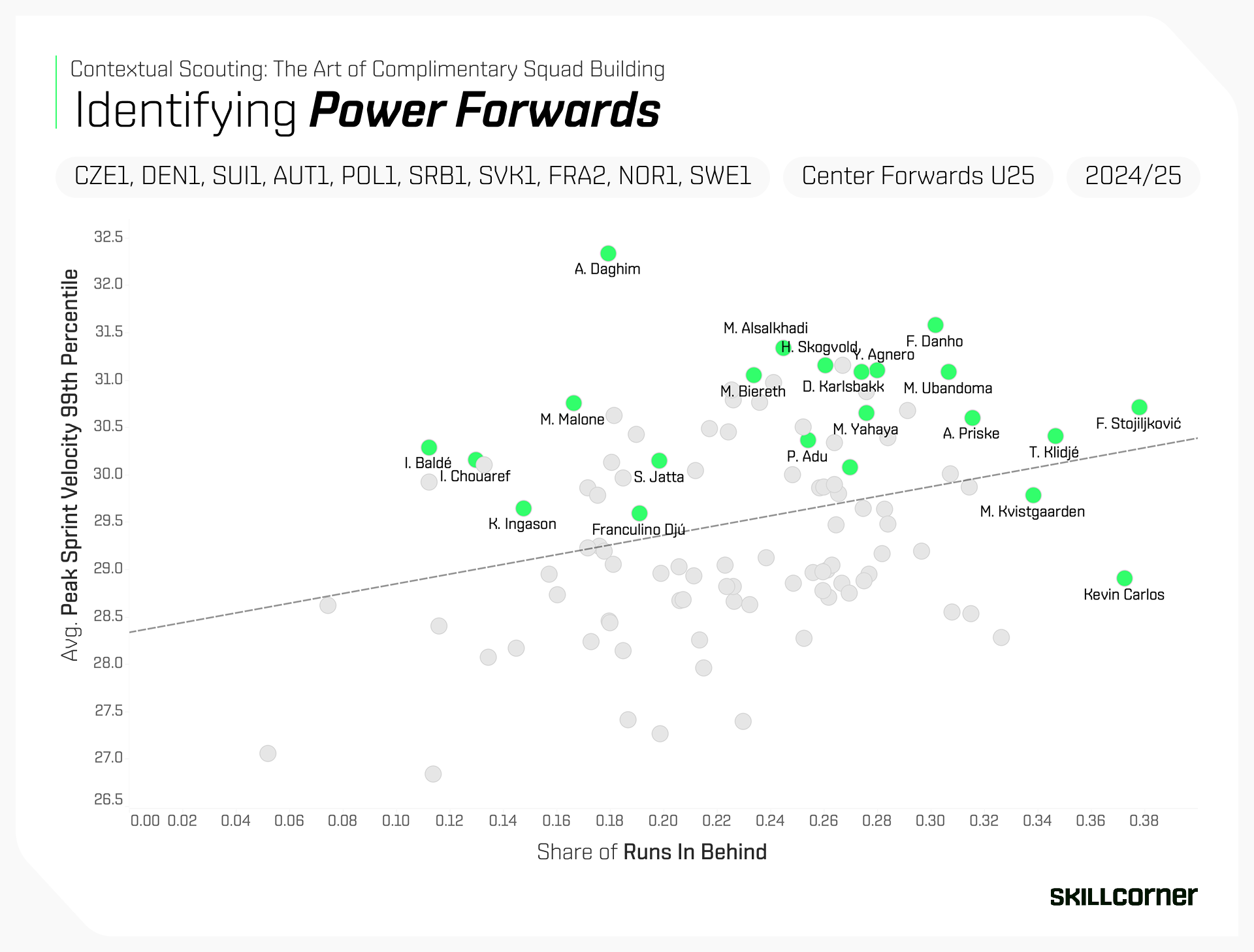
The chart highlights several promising center forwards. The fastest is Adam Daghim, currently on loan at Wolfsburg. Further to the right, we find two young Norwegian strikers: Henrik Skogvold (Fredrikstad) and Daniel Karlsbakk (Sarpsborg 08). At the far right, a small group of players stand out for their tendency to make runs in behind, with over 30 per cent of their runs falling into this category.
Next, we want to find out which players fall into the target man category. In this case, we are simply going to rank the players by their share of cross receiver runs.
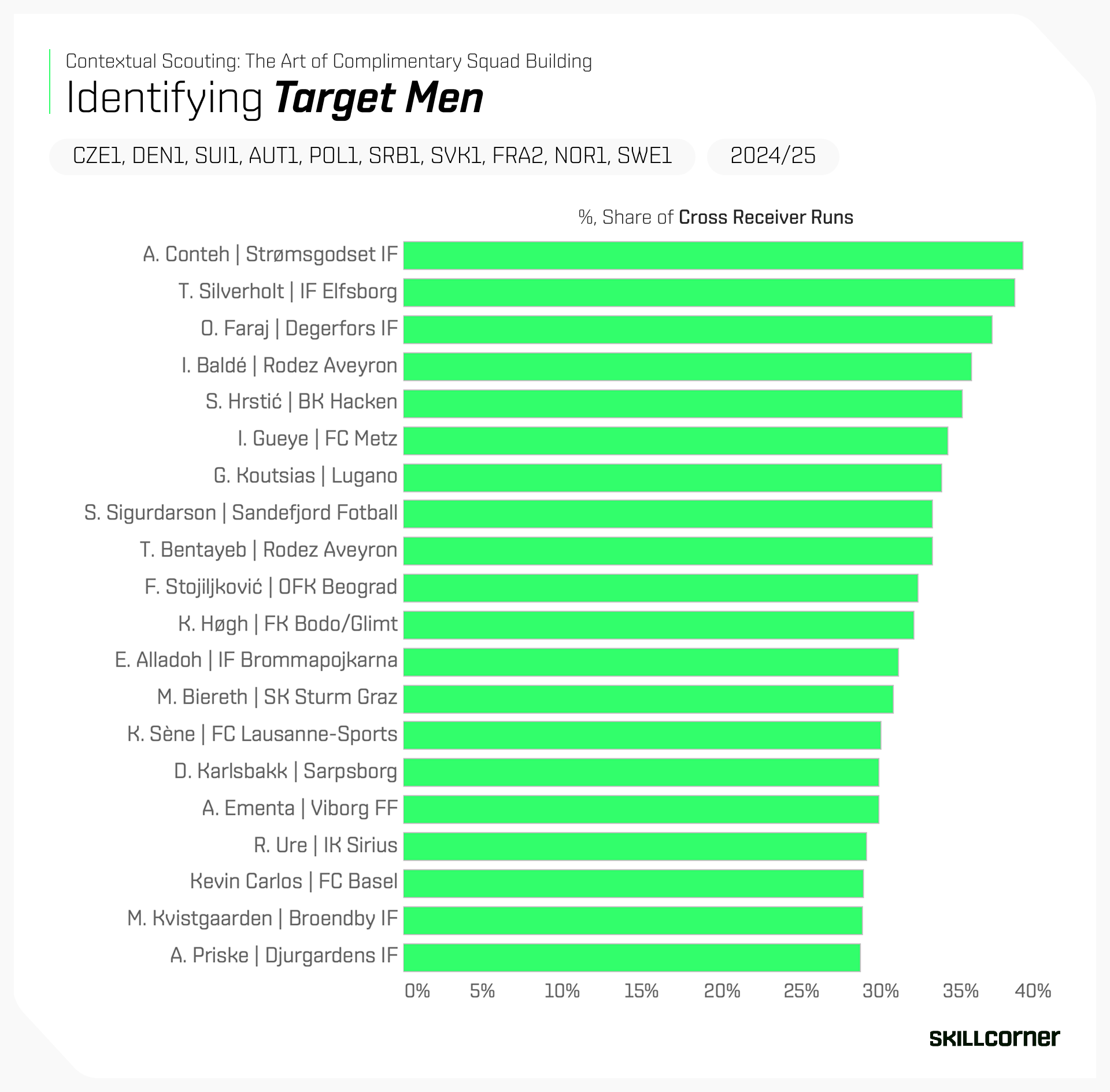
Leading the target man list, Alie Conteh (21) stands out, with almost 40 per cent of his total runs being cross-receiver runs. Following Stromsgodset’s relegation from the NOR1 Eliteserien, Conteh joined Finnish side Inter Turku on loan, with an option to buy. We can also take note of Kasper Høgh (25), who impressed as the focal point of Bodø/Glimt’s incredible run in the Champions League this season.
Another intriguing target man is Anosike Ementa, towering at 202 cm. Signed by Zulte Waregem in the BEL1 Pro League, Ementa combines extreme physicality with a surprising movement profile - his most frequent off-ball run is Pulling Half-Space Runs, and he ranks in the 96th percentile for Dangerous Passes among Belgian centre forwards in the current season.
It’s also worth noting that several Power Forwards from our previous chart appear in the Target Man list. To refine our striker shortlist further, we want to focus on those who contribute to generating the most shots for their teams through their runs.
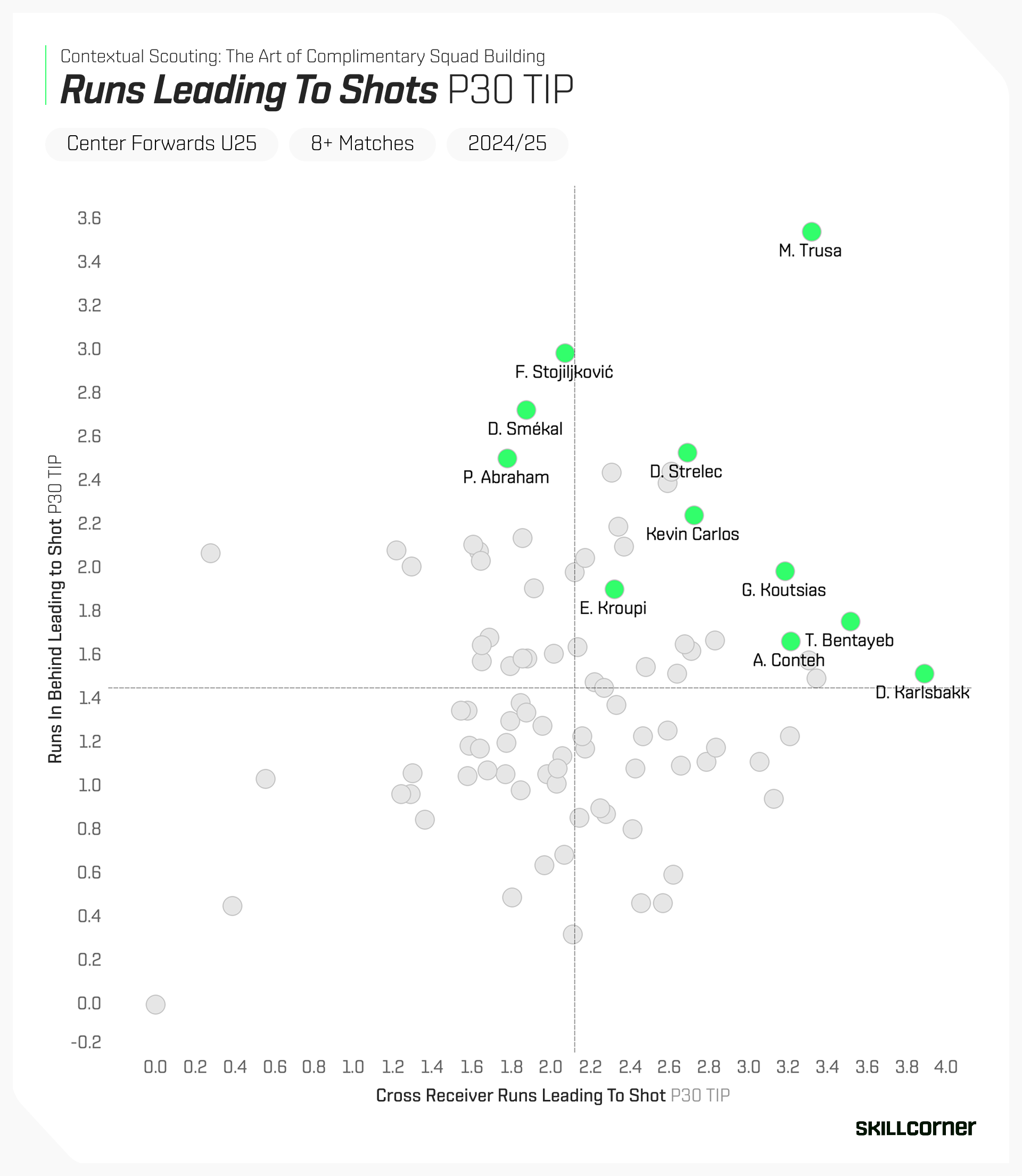
One of the first names that stands out is El Junior Kroupi from his time at Lorient last season. He has since made a strong start in the ENG1 Premier League with Bournemouth. We also find David Strelec, who moved to Middlesbrough from Slovan Bratislava.
Topping the ranking for runs in behind leading to shots, however, is Matej Trusa, who still plays in the SLK1 Nike Liga.
As we are leaning towards a slightly younger profile, Daniel Karlsbakk emerges as a particularly interesting option. He leads all players for cross-receiver runs leading to shots and has featured in our two previous charts both as a Power Forward and as a Target Man. After returning to Sarpsborg 08 in Norway following his first move abroad to the NED1 Eredivisie, he scored 18 goals and finished as the top scorer in Norway’s first division last season.
Another profile worth highlighting is Tawfik Bentayeb. He ranked highest in our Box Crashing metric among centre forwards, averaging 3.1 one-touch shots in the penalty area per 30 TIP. The Moroccan appears to have maintained that level this season, already recording 12 goals in 18 games, with only 14 starts, for Troyes in FRA2 Ligue 2.
Let’s have a look at the off ball profiles of our shortlisted striker prospects:
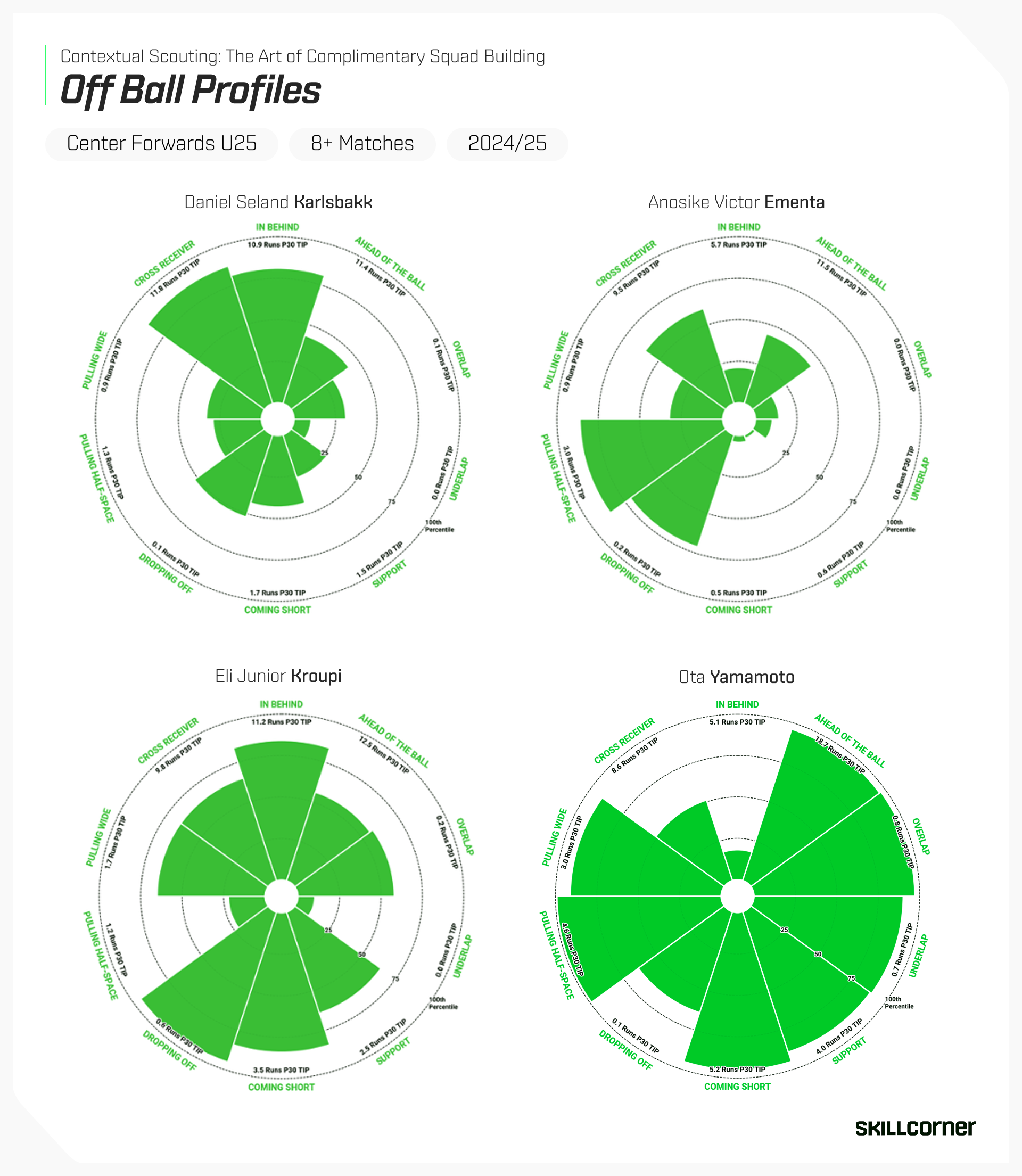
Daniel Karlsbakk will be our main target, as he ranks highly for the two most central run types; runs in behind and cross receiver runs.
The second profile we would like to add to our squad is Anosike Ementa because of his unique profile, reminiscent of Nick Woltemade and the rare Gravitar Archetype developed by SCOUTED. He can give us something different as an option at center forward, either through general hold-up play or as a weapon against aggressive sides, targeting his teammates in behind.
Lastly, we also wanted to show Eli Junior Kroupi’s off ball profile, which is that of a much more dynamic striker, but we already have a similar profile in Ota Yamamoto here with experience as a center forward too (although lacking a bit when it comes to runs in behind).
The Shadow Team
Having reviewed all the main position groups, we can now assemble a shadow team, a structure commonly used in scouting to visualize how potential signings might fit together on the pitch. This allows us to place each player in their intended position and role, giving a clearer picture of how the profiles could function as a collective.
Our preferred starting lineup is highlighted below in the shadow team, while the alternative options, potential substitutions or “gamechangers”, are shown in a more faded tone:
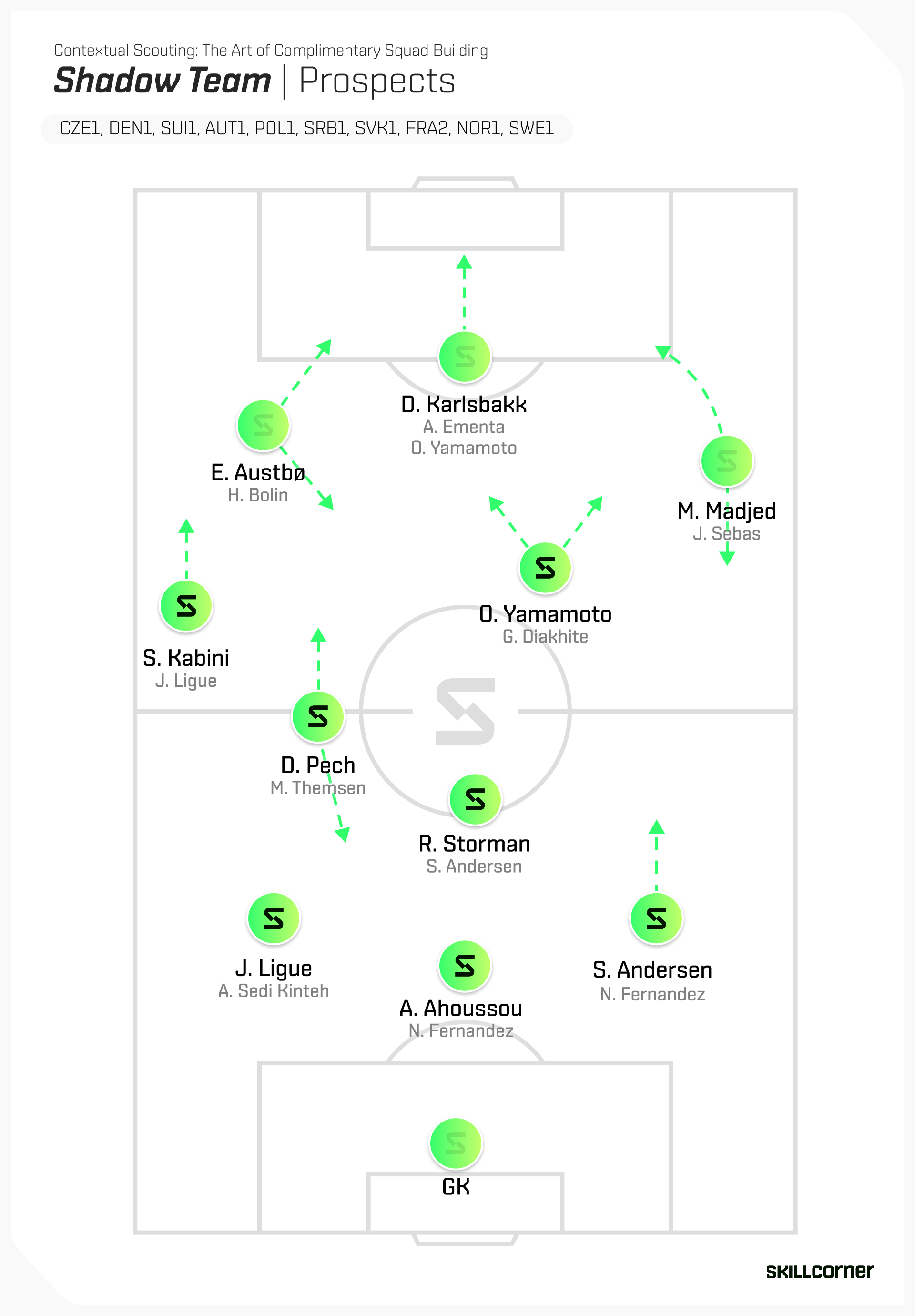
One of the most noticeable aspects of our squad and the profiles we have selected is the tactical flexibility they provide. The team is capable of operating in several different structures depending on the situation.
For example, we can line up in a traditional back four while also shifting into a situational back three thanks to the Flyer archetype on the left side. This allows the fullback to push higher while the rest of the defensive line adjusts behind him.
If we want to take even greater control of possession and dominate games, Silas Andersen can step into midfield, effectively creating a box midfield giving us numerical superiority in central areas. Midfield superiority can also be achieved by selecting a center forward who drops deeper to receive the ball, such as Ementa or Yamamoto.
A third way of creating superiority comes on the left side through local combinations between the Flyer, the Developer and the left winger. This dynamic can overload the flank and create confusion for the opponent. It can also emerge through a simpler movement pattern, with the Flyer pushing high while the left winger drifts into the half space to receive between the lines.
Contextual Scouting: From Data to Decision
Throughout the process, the aim has been to identify a range of complementary profiles. While some players share certain qualities, others bring contrasting strengths and characteristics. This variety provides tactical flexibility and allows the team to adapt depending on specific game situations, strategic priorities, or the way opponents choose to defend.
At the same time, the squad has been assembled with a relatively low average age, aligning with a strategy focused on player development and long term resale potential. Because of this, we need to stay patient and allow the signings time to adjust and grow into their roles and get integrated in the club and new environment.
Scouting players through data is not always straightforward. This is where archetypes and clearly defined profiles, grounded in football concepts and language, become particularly valuable. Context also plays a crucial role, as football is a complex and dynamic game where the same metric can carry different meanings depending on the role or tactical environment.
For that reason, we applied different methodologies and selected different metrics for each position on the pitch. Our hope is that this approach can inspire your own data driven scouting and serve as a starting point for the first stage of the recruitment process: identifying players who fit your tactical ideas and squad building strategy.
Get an overview of all the SCOUTED Archetypes here
.webp)